MacPrevent 5% Sodium Fluoride Varnish with TC...
SKU 90002-Bx
Compare zirconia crowns, strip crowns, and other options for restoring a child’s tooth. Review case factors, workflow, and questions for clinical planning.
When a caregiver asks about an alternative to stainless steel crown for child, the answer depends on the tooth, the amount of sound structure remaining, the child’s needs, and the expected life of the primary tooth. Zirconia crowns, strip crowns, and direct restorative materials may be appropriate in selected cases, but none is a universal substitute for full-coverage treatment. This comparison gives dental teams a practical framework for discussing options and planning supplies without replacing clinical judgment.
Discuss professional dental supply needs at (646) 368-8356
Families may use “alternative” to mean a tooth-colored crown, a filling instead of a crown, or a less involved treatment. Those are different clinical questions. A zirconia crown is also a full-coverage restoration. A strip crown is a tooth-colored composite restoration formed in a clear shell, most often considered for anterior primary teeth. A direct filling restores a more limited area and does not provide the same form of coverage as a crown.
Start by clarifying the concern behind the question. A caregiver may be focused on appearance, metal sensitivity concerns, treatment duration, cost, or whether a crown is needed at all. A useful conversation separates those preferences from the clinical indication. Explain what the tooth needs, what each option can and cannot address, and which alternatives are realistic for that specific tooth.
The evidence does not establish one crown material as best for every child. A comparative review of primary mandibular first molar crowns describes stainless steel crowns (SSCs) and other prefabricated options, while a small study summarized in the Journal of the American Dental Association suggests similar clinical outcomes for zirconia and stainless steel crowns after two years. These findings are useful context, not a guarantee for an individual case. Consider study size, follow-up, tooth type, technique, and the child’s clinical circumstances when interpreting comparisons. (Review of primary molar crown options.)
Selection begins with the tooth and the treatment goal. The following comparison is a discussion aid, not a treatment protocol. Indications vary with clinical findings, product instructions, operator experience, and the child’s ability to tolerate the procedure.
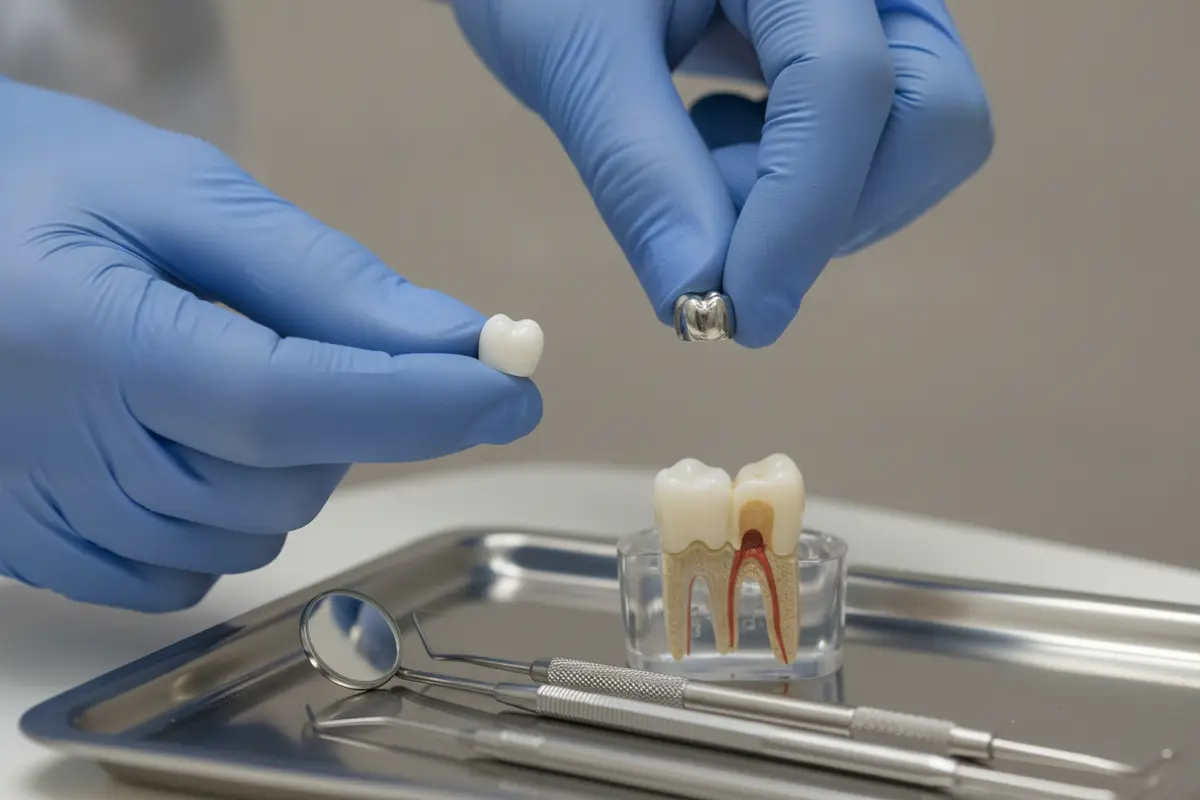
| Option | Typical role in the discussion | Key considerations | What the team should plan for |
|---|---|---|---|
| Preformed zirconia crown | Full coverage with a tooth-colored appearance, often considered for primary teeth where a crown is indicated | Requires a compatible tooth preparation and appropriate fit; material is rigid and cannot be crimped like an SSC | Confirm sizing, preparation requirements, isolation needs, and cementation instructions for the selected system |
| Strip crown with composite resin | Tooth-colored restoration, especially for suitable primary anterior teeth | Technique-sensitive; moisture control and adequate remaining tooth structure matter | Prepare for isolation, composite placement and finishing, and the child’s cooperation during the procedure |
| Direct composite or compomer restoration | Restoration of a limited defect when full coverage is not indicated | Not equivalent to a crown; case selection depends on lesion extent, remaining structure, and caries risk | Match the restorative approach to isolation, cavity design, and the planned recall or monitoring needs |
| Glass ionomer or resin-modified glass ionomer restoration | May be considered for selected restorative or interim situations | Indications and expected performance depend on material, site, loading, and clinical conditions | Follow the product’s handling, placement, and setting instructions; do not treat it as an automatic crown substitute |
| Continued monitoring or another treatment plan | Considered only when examination supports that course | Depends on symptoms, disease activity, tooth prognosis, and risk of progression | Explain follow-up, warning signs, and the rationale for the selected plan to the caregiver |
A preformed zirconia crown may meet a caregiver’s preference for a tooth-colored full-coverage restoration when the tooth needs a crown and the selected system’s preparation and seating requirements can be met. It can be considered on primary molars and anterior teeth according to the manufacturer’s indications and the clinician’s training. Confirm the device’s size range and intended use before ordering; crown designs and instructions are not interchangeable across systems.
Unlike a malleable stainless steel crown, zirconia is rigid. The preparation must provide the clearance and path of seating required by that crown system. A clinician generally cannot rely on chairside crimping to adjust the margins after the crown is selected. That makes preoperative assessment, tooth reduction, try-in, and confirmation of complete seating important parts of the workflow. If the fit is not acceptable, forcing the restoration into place is not a solution.
Appearance is only one selection factor. Discuss the trade-offs in preparation, fit, technique, isolation, cementation, and available sizes. Published comparisons of SSCs and zirconia crowns provide useful but limited evidence; study findings should be interpreted in light of their methods and follow-up rather than converted into a promise of equal performance in every setting. The JADA summary of a small comparative study is one example of why clinicians should state the limits of available evidence clearly.
Strip crowns are a distinct approach, most often associated with restoring primary anterior teeth. A clear crown form is filled with composite resin, seated over the prepared tooth, and removed after the material has set according to the chosen technique. The result can provide a tooth-colored contour, but success depends on appropriate case selection and moisture control. The method is not a simple drop-in substitute for an SSC on a primary molar.
Direct composite, compomer, or glass ionomer materials may be reasonable when a defect can be restored without full coverage or when a specific interim strategy is clinically appropriate. The clinician must evaluate how much tooth structure remains, the extent and location of caries, the child’s caries risk, isolation, and loading. A small restoration and a crown address different conditions. Avoid describing a filling as an equivalent replacement when the reason for recommending full coverage remains present.
For any direct restorative approach, plan the isolation and material sequence before starting. Keep products organized by procedure, verify that the selected material is within its use date, and follow its instructions for mixing, placement, curing or setting, and finishing. A dental mixing pad can support an operatory setup when the chosen material calls for a pad-based mix; it should not be assumed compatible with every product or technique.
Record which tooth is being treated, whether it is primary or permanent, the surfaces involved, the extent of existing restoration or structural loss, symptoms, and the expected time before exfoliation when relevant. Assess whether full coverage is indicated and whether the remaining tooth structure can support a less extensive restoration. A crown material preference should not bypass that assessment.
Also consider the child’s medical and behavioral context, caries risk, oral hygiene, occlusion, and ability to return for follow-up. The same material choice may not be suitable for two children with different clinical findings or cooperation. If the tooth has a guarded prognosis or symptoms that change the treatment plan, discuss the broader options with the caregiver rather than narrowing the conversation to crown color.
Expected time to exfoliation is one factor, not a shortcut around diagnosis. A primary tooth close to exfoliation may raise a different planning question from one expected to remain functional for longer, but the clinician still needs to assess disease, symptoms, restorability, and the consequences of delaying care. Explain how monitoring would work if it is part of the plan, including the timing of reassessment and the changes that would warrant an earlier evaluation.
For permanent teeth in a child, do not assume that a primary-tooth crown comparison applies. Consider the developmental stage, remaining tooth structure, pulpal status, and long-term restorative plan. The article and the cited comparative evidence focus on primary teeth; clinical decisions for permanent dentition require assessment specific to that tooth and patient.
Think through anterior versus posterior location, visibility, occlusal forces, the design of the restoration, and whether the operative field can be managed as required. A tooth-colored material may address esthetics, but the restoration still must meet the needs of the site. Review the manufacturer’s instructions for intended use, preparation, cement or bonding protocol, and any restrictions.
For zirconia, verify the fit and required preparation before cementation. For strip crowns and direct restorations, plan moisture control and material handling. For any cement or restorative material, use the instructions for that product rather than relying on a generic sequence. The clinical team can keep procedural consumables—such as exam gloves—available in the operatory while maintaining the practice’s infection-prevention protocols.
Ask what matters most to the family: appearance, the number of appointments, treatment tolerance, or understanding why a crown was recommended. Explain the expected procedural differences in plain language and identify uncertainties. Do not promise that one material will last longer, feel better, or prevent future treatment unless evidence and the case support that claim.
Use shared decision-making while staying clear about the clinician’s recommendation. If the caregiver’s preferred option is not appropriate for the tooth, explain why and offer the clinically suitable alternatives. Document the discussion, including the proposed treatment, material choice, relevant risks and limitations, and the caregiver’s questions and decision.
A repeatable planning checklist can reduce avoidable interruptions without turning every case into the same protocol:
A short pre-procedure huddle can align the clinician and assistant on the restoration selected, the anticipated sequence, and the contingency if the preferred option does not fit or cannot be completed under the conditions encountered. Keep alternatives available only when clinically and operationally appropriate; do not let a stocked size or material drive the diagnosis. After treatment, record the material and relevant product or lot details according to practice policy, along with any issue that could inform future case planning.
When reviewing crown systems for the practice, compare more than the package price. Confirm intended dentition and tooth range, size assortment, preparation and seating instructions, cement requirements, storage conditions, and the availability of the specific sizes the practice expects to use. Staff education matters as well: a change in restoration system may require the team to learn a different preparation and seating workflow. Keep the product instructions accessible and orient team members before the material is introduced into routine use.
For dental supply purchasing, focus on accurate product specifications, intended use, compatibility, and dependable replenishment. Keep systems and material instructions accessible to the team. A supply order should support the clinician’s selected treatment plan—not determine it.
Caregivers do not need a catalogue of materials without context. A brief comparison that distinguishes full coverage from a direct restoration is more useful. Explain why a crown is or is not recommended, what the chosen material changes about the procedure, and what it does not change about the tooth’s underlying condition.
One practical sequence for the conversation is:
Use visual aids or a model when available, and avoid framing the discussion as “metal versus white” alone. Material appearance is visible; preparation requirements, fit, isolation, and clinical indication are just as important. When evidence is limited or differs by tooth and technique, say so directly.
Contact SurgiMac about dental supply sourcing
A preformed zirconia crown is a tooth-colored full-coverage option for selected primary teeth. It has different preparation and seating requirements from an SSC, so it is not a direct, interchangeable substitute. The clinician should confirm indication, fit, and the system’s instructions.
Sometimes a direct restoration is appropriate, but a filling and a crown do not provide the same coverage. Whether a filling is suitable depends on the extent of the defect, remaining tooth structure, caries risk, tooth location, and other clinical findings. Ask the treating dentist why full coverage was recommended for that tooth.
No single material is proven best for every case. Comparative studies offer useful information, but findings depend on study design, follow-up, tooth type, and technique. A small study summarized by JADA reported similar clinical outcomes over two years; that result should not be generalized into a guarantee for every patient.
Strip crowns are commonly associated with selected primary anterior restorations and should not be treated as the routine equivalent of a posterior crown. The clinician will consider the tooth, defect, isolation, material, and expected loading before choosing a restoration.
The best alternative to stainless steel crown for child is the option that fits the tooth’s clinical needs and the child’s circumstances—not simply the one with the most appealing color. Compare full-coverage crowns with direct restorations accurately, discuss evidence and limitations, and plan the materials and workflow for the selected technique. A clear, case-specific explanation helps the dental team and caregiver make an informed decision together.