

Dental Suction Tip Types: A Guide for Modern Practices
- , by SurgiMac
- 13 min reading time
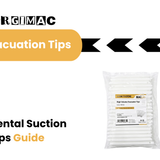
Schedule a free consultation on dental suction tip types. Compare HVE, saliva ejector, and surgical aspirator designs for safer, efficient evacuation.
Evacuation performance depends on more than connecting a tube to the dental unit. The tip must match the volume and character of fluid, debris, and aerosols produced during the procedure, while the evacuation system must remain clear and properly disinfected.
Source professional-grade dental suction tips for your practice from SurgiMac.
Dental suction tip types generally fall into high-volume evacuator (HVE) tips, saliva ejectors, and specialized surgical or micro-aspirator tips. HVE tips manage larger volumes of fluid, debris, and aerosols, while saliva ejectors support lower-volume fluid removal. Selecting the appropriate design improves visibility, patient comfort, and evacuation efficiency, as summarized by Dental Compare.
For U.S. dental practices, the right choice also depends on procedure demands, infection-control policy, material compatibility, and whether the device is intended for single-patient use or validated reprocessing. The distinctions among common tip designs provide the foundation for making that decision consistently.
What Are the Main Dental Suction Tip Types for Modern Practices?
Suction tip designs are differentiated by the volume of material they evacuate, the clinical setting, and the degree of access required. Selecting the correct attachment helps maintain a clear field, support efficient chairside workflow, and match evacuation performance to the procedure.
High-Volume Evacuator Tips
High-Volume Evacuator (HVE) tips are designed to remove large volumes of fluid, debris, and aerosols. They are commonly selected for restorative procedures, crown preparation, ultrasonic scaling, and other treatments that generate substantial spray or particulate matter. A broad opening and high-capacity evacuation path allow the assistant to manage fluid near the operative site while supporting visibility. The tip should be positioned close enough to capture material effectively without interfering with the clinician's access or causing unnecessary patient discomfort. Dentalcompare identifies HVE tips as the high-volume option for fluid and debris removal.
Saliva Ejectors
Saliva ejectors are intended for low-volume fluid removal rather than heavy debris or aerosol management. Their smaller profile is useful during examinations, routine restorative care, and procedures in which continuous saliva control is needed but high-volume evacuation would be excessive. Because the ejector may remain in position for longer periods, teams should consider patient comfort, soft-tissue contact, and reliable connection to the evacuation line when selecting a design.
Surgical Aspirator Tips
Surgical aspirator tips are built for surgical environments, where controlled access and visibility can be more important than broad-volume evacuation alone. Their geometry and size may differ from standard HVE tips. Allowing the clinician to work around a smaller operative field or manage blood and irrigation fluid with greater precision. The appropriate shape depends on the procedure, access requirements, and compatibility with the handpiece and tubing.
Micro-Aspirators
Micro-aspirators support focused aspiration in confined areas and are available in application-specific gauges. Examples include 18 ga yellow and 20 ga aqua configurations. These narrow attachments can help remove localized fluid without obstructing delicate instrumentation or the clinician's view. Confirm the gauge, connector, and intended use before ordering, particularly when sourcing replacement tips for a surgical or endodontic setup. Matching the attachment to the evacuation system and procedure is more useful than choosing solely by external size.
Across these categories, the best choice is the one that provides dependable evacuation while preserving access, visibility, and patient tolerance.
How to Choose the Right Dental Suction Tip for Each Procedure
Tip selection should follow the clinical demands of the procedure, not simply the connector size available on the dental unit. The correct design supports a clear operating field, reduces unnecessary contact with oral tissues, and helps the evacuation system maintain effective flow. Research and clinical guidance identify proper selection as a factor in visibility, patient comfort, and overall evacuation performance.
High-volume evacuation (HVE) is central to fluid and debris management, particularly during procedures that use rotary instrumentation, air-water spray, or ultrasonic devices. It is also an important part of aerosol control in modern dentistry. Because the tip is the point where aerosols are captured, its diameter, opening, positioning, and distance from the operative site can directly affect capture efficiency. Review the clinical overview of suction attachments when standardizing tip selection across operatories.
Restorative procedures
For restorative treatment, choose an HVE tip that provides strong evacuation without obstructing the handpiece, mirror, or direct line of sight. A broad, rigid tip is often useful when the procedure generates substantial spray, coolant, or restorative debris. Position it close enough to the working area to capture fluid at the source, while avoiding unnecessary pressure against the cheek, tongue, or floor of the mouth. When access is limited, a slimmer or angled HVE design may improve retraction and visibility without requiring the assistant to reposition repeatedly.
Surgical procedures
Surgical sites require controlled aspiration and a tip geometry suited to restricted access. Surgical aspirators differ from standard HVE tips in their dimensions and shapes, which are designed to support visibility around an incision or extraction site. Select a narrow, appropriately angled aspirator when precise fluid removal is more important than covering a wide field. The opening should remain visible to the assistant and should not rest directly on delicate tissue. For deeper or highly localized aspiration, micro-aspirators may provide the control needed for the field; available gauges can vary by product and application.
Hygiene and aerosol-generating procedures
During ultrasonic scaling and other hygiene procedures, use HVE when practical to manage irrigation, saliva, and aerosolized material. A tip with a stable, comfortable profile allows the assistant to maintain consistent placement while the clinician works. Saliva ejectors may be appropriate for low-volume fluid collection or patient comfort between active aerosol-producing steps. But they are not a substitute for HVE when substantial spray and debris are present.
Before each appointment, confirm that the selected tip is unobstructed, securely connected, and compatible with the evacuation system. If flow drops or the opening becomes clogged, clear or replace the tip immediately. Standardizing procedure-specific choices in the operatory setup helps the team work efficiently while preserving visibility and patient comfort.
Source dependable suction supplies for your practice from SurgiMac.
Disposable vs. Reusable Suction Tips: Which Is Right for Your Practice?
The choice between disposable and reusable suction tips affects patient turnover, instrument processing, and infection-control reliability. Single-use devices are intended for one patient only and should be discarded according to the manufacturer's instructions, while reusable devices require validated reprocessing after every patient. The CDC infection-control guidance should remain the governing reference for practice policies.
Source dependable evacuation and infection-control supplies for your operatory.
| Consideration class. | Disposable tips. | Reusable tips. |
|---|---|---|
| Typical material. | Most plastic tips and other products labeled single-use. | Metal tips and other products specifically labeled heat-tolerant and reusable. |
| Processing. | Use for one patient, then discard as directed by the manufacturer. | Clean and sterilize rigorously after each patient use, following the manufacturer's reprocessing instructions. |
| Best use. | High-turnover workflows, complex geometries, and heat-sensitive components. | Durable metal designs when the practice has validated sterilization capacity and adequate processing time. |
Material and heat tolerance determine the workflow
Autoclavability is not a safe assumption based on appearance alone. Metal tips are typically reusable and heat-tolerant, whereas most plastic tips are manufactured for single use. A semicritical item that cannot tolerate heat should be replaced with a heat-tolerant or disposable alternative, according to the CDC. Always confirm compatibility, cycle parameters, and reprocessing limits in the product instructions before placing a tip in an autoclave.
Cost can also influence a defensible policy. Some disposable aerosol suction devices cost less than one dollar each, making single-use deployment practical even when a product may technically tolerate autoclaving. Many practices are moving toward disposable tips because infection-control expectations are higher and manual sterilization of complex components consumes staff time.
Build infection control into purchasing decisions
Choose a tip format that your team can use consistently, identify clearly, and process without shortcuts. Pair disposable suction components with appropriate barrier and PPE procedures, and maintain written instructions for reusable-device processing near the reprocessing area. SurgiMac's MacSafe infection control products can support a broader infection-prevention purchasing strategy, but they do not replace manufacturer instructions, sterilization validation, or CDC-based protocols.
How Should You Maintain and Troubleshoot Your Dental Suction System?
Reliable evacuation depends on more than choosing the right tip. Dental unit suction systems can become heavily contaminated with environmental and human-derived bacteria during use, making a documented maintenance routine essential for infection prevention and consistent clinical performance.
Inspect the tip and tubing before and during treatment. Check the opening, adapter, hose, filter housing, and visible connections for debris, cracks, loose fittings, or restricted flow. A clogged tip can reduce visibility, compromise fluid and aerosol control, and create patient discomfort. Clear the obstruction or replace the tip immediately rather than continuing with reduced evacuation. Keep dependable high volume evacuator tips available for routine procedures.
Separate patient-use replacement from system disinfection. Single-use tips and attachments should be used for one patient only and discarded according to the manufacturer's instructions. Reusable components require the full reprocessing sequence specified by the manufacturer. Replacing a disposable tip does not disinfect the evacuation line, filter housing, or dental chair unit, so staff should treat these as separate infection-control responsibilities.
Disinfect the complete evacuation pathway. Research has found that suction systems become contaminated during use and that standard aspiration disinfection can fail to decontaminate them effectively. Flood disinfection substantially improves efficacy and reduces potential cross-contamination compared with simply aspirating disinfectant. See the evidence from PubMed and maintain the negative-pressure pipeline, tubing, and filter components according to the equipment and disinfectant manufacturers' instructions.
Use an automated flood cycle when available. Automated flood disinfection is more reliable than aspirating disinfectant alone because it helps contact surfaces throughout the suction lines. Periodic detection of contamination and regular disinfection maintenance are critical for dental chair unit suction systems, as documented in this PMC review. Record the date, product, cycle, staff member, and any abnormal findings so recurring problems can be identified.
Escalate persistent low suction promptly. If flow remains weak after replacing a clogged tip and checking connections, inspect the trap, filter, hose, and pump service indicators instead of compensating with an undersized attachment. Proper cleaning and disinfection support suction-pump longevity and help prevent suction failure during procedures. For procedures requiring controlled access and visibility, consider precision HVE aspirator tips or appropriately selected surgical aspirators.
A maintenance protocol should define daily checks, between-patient replacement, scheduled system disinfection, documentation, and service escalation. Follow current equipment instructions and your practice infection-prevention policy whenever a product label or device-specific procedure is more stringent.
Why Professional-Grade Suction Supplies Matter for Your Practice
Suction is a clinical support function, but its reliability affects nearly every stage of treatment. A well-matched tip helps maintain a clear field, manage fluid and debris, and reduce interruptions while the clinician works. Consistent evacuation also supports patient comfort by limiting fluid accumulation and the need for repeated repositioning.
Professional-grade supplies give practices a more dependable way to match evacuation equipment to the procedure, operatory setup, and expected volume of fluid or debris. HVE tips, saliva ejectors, and surgical aspirators are not interchangeable in every clinical situation. Tip geometry, connection fit, rigidity, and working profile can all influence maneuverability and evacuation performance. Selecting products designed for professional dental use helps the team maintain a predictable workflow instead of adapting to inconsistent equipment during treatment.
Brand selection can also simplify sourcing and standardization across operatories. SurgiMac carries established options such as Dukal aspirating tips, Safe-Dent HVE tips, and the Centrix MicroAspirator. These products support different use cases, from routine high-volume evacuation to more focused aspiration where access and visibility matter. The Centrix MicroAspirator, for example, is suited to precision aspiration applications where a smaller working profile is useful. Practices should still confirm compatibility, intended use, and reprocessing requirements in the manufacturer documentation.
Quality is not limited to the tip itself. A dependable supply program should make it easier to maintain appropriate inventory, replace single-use components between patients, and keep compatible products available for routine and surgical procedures. The CDC advises that single-use devices be used for one patient only and discarded appropriately, while reusable devices must be reprocessed according to manufacturer instructions. Review the CDC's dental instrument processing guidance when setting purchasing and reprocessing policies.
For U.S. dental professionals comparing suction tip options, SurgiMac provides a national source for premium, reliable, and affordable dental and surgical supplies. The goal is practical: equip each operatory with evacuation tools that support precision, procedural efficiency, and a consistent standard of patient care.
Contact SurgiMac to equip your operatory with dependable evacuation supplies today.
Frequently Asked Questions
What are the different types of dental suction tips?
The main categories are high-volume evacuator (HVE) tips for larger volumes of fluid, debris, and aerosols, and saliva ejectors for lower-volume fluid removal. Surgical aspirators and micro-aspirators provide more specialized control for operative fields and fine suction applications. Dental suction attachment categories vary by geometry, diameter, and intended procedure.
What is the difference between HVE and saliva ejector tips?
HVE tips connect to a higher-capacity evacuation line and are selected when the clinician needs rapid removal of water, debris, or aerosols near the operative site. Saliva ejectors provide gentler, continuous removal of pooled saliva and limited fluid. Matching the tip to the procedure supports visibility and patient comfort. Compare HVE and saliva ejector functions.
How often should you replace dental suction tips?
Use a disposable tip for one patient only, then discard it according to the manufacturer instructions. A reusable tip must undergo the complete recommended cleaning and sterilization process after every patient use. Keep reprocessing instructions accessible to the team, and do not reuse a single-use device between patients. CDC reprocessing guidance supports this approach.
Are dental suction tips autoclavable?
Autoclavability depends on the specific material and product labeling. Heat-tolerant metal tips are commonly designed for reuse and sterilization, while many plastic tips are intended for single use. If a semicritical device cannot tolerate heat, select a validated heat-tolerant or disposable alternative rather than substituting an unapproved disinfection method. Follow CDC and manufacturer instructions.
Ready to Source Reliable Evacuation Supplies?
Consistent suction performance depends on selecting tips that match your procedures and maintaining dependable evacuation supplies. Call SurgiMac to discuss professional-grade dental suction tips and related practice needs. Call SurgiMac at (646) 421-4136 to get started with a sourcing conversation tailored to your clinical environment.
Tags
Blog posts
-
, by SurgiMac A Clinician's Guide to Absorbable Suture Material
-
, by SurgiMac A Clinician's Guide to Dental Composite Resin Kits
-
, by SurgiMac How to Disinfect with Metrex CaviWipes Correctly
