
Dental Explorer Probe Types: A Complete Guide
- , by SurgiMac
- 14 min reading time
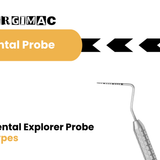
Get a detailed guide to dental explorer probe types for dental professionals. Choose the right explorers, probes, and combination instruments for your practice.
Small differences in tip shape, angulation, markings, and handle design determine whether a diagnostic instrument gives you useful tactile information or creates unnecessary hand strain. Selecting the right instrument starts with matching its design to the surface, tissue, or deposit you need to assess.
Dental explorer probe types serve different diagnostic purposes: explorers use fine, often sharp tips to detect calculus, caries, and surface irregularities. While periodontal probes use graduated markings and rounded tips to assess pocket depth and gingival tissue atraumatically.
Understanding that distinction makes instrument selection more deliberate. The sections that follow explain how explorers and probes are constructed, how their working ends differ, and which designs best support routine examinations, periodontal charting, and focused detection.
What Are Dental Explorer Probe Types?
Dental explorers and periodontal probes are diagnostic hand instruments, but they answer different clinical questions. An explorer helps the clinician detect changes on a tooth surface through tactile feedback. A periodontal probe provides graduated measurements used to assess gingival and periodontal tissue health. Understanding that distinction supports appropriate instrument selection and more consistent examinations.
Dental explorers detect surface irregularities
A dental explorer is typically a thin, flexible stainless steel instrument with a sharp working tip. The clinician uses it to examine tooth surfaces and detect calculus, defects, or other irregularities that may not be obvious during visual inspection. As the tip moves across enamel, restorations, pits, fissures, or root surfaces, tactile feedback can help identify changes in texture and continuity. The metal tip may also produce a distinct sound when it contacts a hard calculus deposit.
Explorer design matters because the working end and handle influence how vibrations transfer from the tooth to the practitioner's fingers. Tip shape, angulation, and access should match the surface being examined. A carefully controlled exploratory stroke is intended to gather diagnostic information without replacing visual inspection, radiographs, or other appropriate caries-detection methods.
Periodontal probes measure tissue conditions
A periodontal probe is a graduated instrument with a thin, resilient shaft and a rounded tip. Its atraumatic working end is designed for controlled insertion along the gingival margin and into the sulcus or periodontal pocket. The graduations give the clinician a reference for probing depth, a critical measurement when assessing gingival tissue health and monitoring periodontal conditions over time. Probe markings can vary by design, so the clinician should know the instrument's scale before recording findings.
Unlike an explorer, a probe is not primarily intended to locate surface defects by sharp tactile contact. Its purpose is measurement and tissue assessment. The rounded tip and smooth working end help support atraumatic probing when appropriate technique and force are used. Findings should be interpreted alongside bleeding, inflammation, recession, attachment levels, mobility, radiographic evidence, and the patient's broader clinical presentation.
Choosing a practical diagnostic setup
Many examinations require both instruments. The explorer evaluates tooth and restoration surfaces, while the periodontal probe documents sulcus or pocket measurements. A balanced handle can improve control during repeated passes and reduce hand strain during a full clinical day. SurgiMac's Air Series instruments are designed for ergonomic handling, making them a practical option for dental professionals building a precise diagnostic setup.
In short, explorers detect surface irregularities; probes measure periodontal depth and assess gingival tissues. Keeping those functions distinct helps clinicians select the right working end for each step of the examination.
Common Types of Dental Explorers
Explorer selection should follow the surface, angulation, and deposit you need to assess. The working end determines how easily the instrument reaches interproximal areas, occlusal anatomy, the gingival sulcus, or deeper periodontal pockets. Understanding these design differences helps clinicians choose an instrument that provides access without sacrificing tactile control.
Sickle explorers for calculus and caries assessment
The SG5 is a classic sickle explorer used for calculus detection and paired with an Orban-type explorer for caries detection. Its pointed, angular working end is well suited to tracing irregularities and interproximal areas where a straight tip may not adapt as effectively. Sickle geometry can also help the clinician engage deposits along margins and narrow contact areas.
Because explorer shapes offer different advantages across tooth surfaces, a sickle design should be selected for the access it provides rather than treated as an interchangeable general-purpose tip. The relationship between tip shape and angle is especially important when examining posterior teeth or areas where direct visualization is limited. Clinical instrument guidance on explorer design describes how these variations support surface-specific examination.
Pigtail and angled explorers for targeted access
The S3C pigtail explorer has both right and left angulations. That configuration allows the clinician to approach specific tooth surfaces from the appropriate direction, which can improve adaptation during focused examination. Pigtail and sickle forms are not simply cosmetic variations. Their curves and angles change the path the tip takes around anatomy. This makes one design more practical than another for a particular surface or contact.
#11/12 explorers for sulcus and pocket assessment
The DH2 #11/12 explorer is noted for detecting calculus in a healthy gingival sulcus and in deep pockets. Its working-end configuration supports subgingival exploration where controlled insertion and consistent tactile feedback are essential. The #11/12 explorer is also frequently used in periodontal research for subgingival calculus detection. Reinforcing its role as a specialized diagnostic instrument rather than only a routine surface explorer.
Material, construction, and tactile feedback
Explorers communicate information through touch, and sometimes through sound. When a metal tip contacts hard tartar, it may produce a distinct ringing sound that helps alert the clinician to a deposit that is difficult to see. Tactile feedback also depends on how efficiently vibration travels from the working end through the shank and handle. Double-ended explorers made from a single piece of steel are designed to minimize vibration dampening, supporting a more direct feel at the fingers.
Handle ergonomics matter during prolonged examinations and repeated patient care. The SurgiMac Air Series offers an ergonomic option for clinicians who want a more comfortable grip while maintaining precise control of diagnostic instruments. Pair the handle design with the tip geometry and clinical access requirements, then verify findings with the appropriate periodontal probe when pocket measurements are indicated.
Essential Types of Periodontal Probes
Periodontal probes differ in graduation, tip design, material, and visual contrast. Selecting the appropriate probe improves measurement consistency while helping clinicians protect gingival tissues, implant surfaces, and patient comfort during assessment. The markings should be easy to read, and the working end should support controlled insertion without catching or traumatizing tissue.
| Probe Type | Markings | Key Feature | Primary Application |
|---|---|---|---|
| HH12 | 3-6-9-12 mm | Clear graduated reference points | Routine periodontal pocket-depth measurements and full-mouth charting |
| UNC15 | 1-15 mm | Fine, sequential graduations | Detailed periodontal measurements when incremental depth readings are useful |
| WHO probe | 3.5-5.5-8.5-11.5 mm | Ball tip for screening | Standardized periodontal screening and community or clinical examination protocols |
| PEEK implant probe | Model-dependent | Nonmetallic thermoplastic working end | Peri-implant tissue assessment around titanium implants, where surface protection matters |
| DBS12 biotype probe | Model-dependent | Black finish creates contrast against gingiva | Gingival phenotype assessment, including evaluation based on tissue transparency |
HH12 and UNC15 probes use graduated markings as a visual aid for pocket-depth measurement, with the UNC15 offering a more sequential 1-to-15 mm scale. A WHO probe uses 3.5, 5.5, 8.5, and 11.5 mm reference points with a ball tip, making it suited to standardized screening. These specifications are documented in the instrument reference from Deppeler.
For implant maintenance, PEEK probes are designed for use around titanium implants without the same risk of scratching the implant surface associated with unsuitable metal instruments. A DBS12 biotype probe takes a different approach: its black color increases visual contrast against the gingiva, helping clinicians assess gingival phenotype and tissue transparency.
Atraumatic tip design matters
Regardless of the marking system, the probe tip should be perfectly rounded and the working end smooth, without notches that can catch tissue. This atraumatic design supports controlled probing and helps reduce unnecessary irritation during repeated measurements. Inspect the tip regularly, because wear or deformation can affect both patient comfort and measurement reliability.
Ergonomics during full-mouth probing
Full-mouth charting can involve hundreds of controlled probing movements. An ergonomic handle can reduce the grip force required and help limit hand fatigue over a long appointment. SurgiMac's Air Series handles are designed for comfortable instrument control, making them a practical option when clinicians perform comprehensive periodontal assessments throughout the day.
Explorer-Probe Combination Instruments
Dual-ended explorer-probe instruments place two complementary diagnostic functions in one handle. One working end supports tactile examination for calculus, caries-related irregularities, or surface defects, while the opposite end provides graduated periodontal measurements. This arrangement can reduce the number of instruments opened on a diagnostic tray and limit interruptions when moving between tooth-surface assessment and periodontal charting.
Match the explorer and probe ends to the examination
The H125 is a practical example: it combines a classic sickle explorer with a periodontal probe marked at 3, 6, 9, and 12 mm. The sickle end supports calculus and caries detection, while the graduated end helps assess probing depths during a periodontal examination. The instrument is not a substitute for selecting a specialized probe when a case requires a different marking system or tip design. Instead, it is useful when routine screening and tactile exploration occur together.
Explorer selection still matters. The #11/12 explorer is frequently used in periodontal research for subgingival calculus detection, including comparative evaluation against a WHO periodontal probe. Its narrow, angled working end can support access in the sulcus and periodontal pockets when controlled tactile assessment is needed. Use light, deliberate pressure and follow the clinical protocol appropriate to the patient and procedure.
Combination options in current instrument catalogs
Market offerings demonstrate how the same concept can be adapted to different measurement preferences. ProDentUSA lists combinations such as a 23 Explorer with UNC12, UNC15, Williams, or CP8 probes, along with other explorer and probe pairings. A UNC12 or UNC15 scale may suit clinicians who want more detailed graduated markings, while Williams and CP-series probes provide alternative charting conventions. Confirm the marking pattern and working-end geometry before standardizing an instrument across operatories.
Improve efficiency without compromising ergonomics
A combination instrument saves tray space only when both ends are comfortable, accessible, and suited to the practice's examination sequence. Handle diameter, balance, surface texture, and weight influence control and tactile feedback during repeated assessments. Air Series ergonomic handles can be integrated into a diagnostic setup when a more comfortable grip and efficient hand positioning are priorities. Review Air Series ergonomic dental instruments alongside the required explorer and probe configurations, then select the pairing that supports consistent technique, clear charting, and efficient instrument transfer.

How to Choose the Right Diagnostic Instrument
The best diagnostic instrument is determined by the clinical task, the anatomy being examined, and the level of tactile control required. A general examination may call for a versatile explorer and graduated periodontal probe. While focused assessment of interproximal surfaces, sulci, or deeper periodontal pockets may justify a more specialized working end.
Match the instrument to the procedure
- Routine restorative examination: Select an explorer with a tip shape and angulation suited to the tooth surfaces being evaluated. Pigtail and sickle configurations can provide different access around pits, fissures, contact areas, and line angles.
- Periodontal assessment: Use a graduated probe with clear, durable markings that support consistent pocket-depth measurements. The working end should be smoothly finished and rounded to support atraumatic probing.
- Deep pockets or subgingival calculus: Choose an explorer that provides controlled access without excessive deflection. The #11/12 explorer is frequently used in periodontal research for subgingival calculus detection, but selection should follow the clinician's technique and the anatomy involved.
- Implant maintenance: Use an implant-appropriate probe, such as a PEEK instrument, when the working end must minimize the risk of scratching a titanium implant surface.
Prioritize tactile feedback and patient comfort
Tactile sensitivity depends on both the instrument material and its design. Those factors influence how effectively vibrations travel from the working end to the practitioner's fingers, which can affect calculus detection and the interpretation of subtle surface changes. Handle diameter, balance, stiffness, and tip geometry also influence control, especially when examining sensitive patients or areas where unnecessary pressure may increase discomfort.
Diagnostic selection should support modern caries management rather than rely on one method in isolation. More than one-third of the world's population lives with untreated dental caries. And a 2017 Global Burden of Disease analysis reported that caries in permanent teeth had the highest prevalence among 328 diseases studied. These findings reinforce the value of careful visual and tactile examination, while optical-based caries detection methods are emerging as alternatives or complements to traditional sharp explorers. Current approaches increasingly emphasize early detection and minimally invasive management. Review the evidence on optical caries detection and contemporary diagnostic recommendations.
Consider ergonomics and examination length
For extensive examinations, practitioner preference matters because a comfortable, stable grip can support consistent technique over time. Ergonomic handles may reduce hand strain without sacrificing access or tactile control. Explore SurgiMac's Air Series ergonomic dental instruments for prolonged diagnostic sessions, and compare them with the Slim Series diagnostic instruments when a narrower profile is better suited to your working style and access requirements.
When evaluating dental explorer probe types, build the selection around the procedure, tooth surface, pocket depth, patient sensitivity, and your established clinical technique. A well-matched set should provide both the access needed for accurate assessment and the control required for a comfortable, repeatable examination.
Frequently Asked Questions
What are the common types of dental explorers?
Common designs include sickle, pigtail, Orban-style, and #11/12 explorers. Tip shape and angulation determine access to specific tooth surfaces. A sickle explorer is useful for calculus assessment, while pigtail designs can improve access around proximal surfaces and posterior anatomy. Double-ended instruments can provide two working configurations without changing instruments.
What is the difference between a dental probe and an explorer?
An explorer is a sharp-tipped tactile instrument used to examine tooth surfaces and identify calculus, defects, or irregularities. A periodontal probe is graduated and has a rounded working end for measuring probing depth and assessing periodontal tissue health. Because their purposes differ, they should not be selected or substituted interchangeably.
Which periodontal probe markings are most useful?
Marking selection should match the examination and documentation system used in the practice. Common options include HH12 markings at 3, 6, 9, and 12 mm. UNC-15 markings from 1 to 15 mm; and WHO markings at 3.5, 5.5, 8.5, and 11.5 mm. Consistent calibration supports repeatable periodontal measurements.
Are specialized instruments available for implant assessment?
Yes. Peri-implant assessment commonly calls for a probe made from a material designed to reduce the risk of scratching the implant surface. PEEK probes are a specialized option for titanium implant maintenance. Use the instrument specified by the implant system and follow the practice's clinical and sterilization protocols.
Contact us for ergonomic diagnostic instruments
The right explorer or periodontal probe can support consistent tactile assessment throughout routine examinations. For premium dental diagnostic instruments and ergonomic Air Series tools, contact SurgiMac to get started with instrument options suited to professional clinical use.
Tags
Blog posts
-
, by SurgiMac A Clinician's Guide to Absorbable Suture Material
-
, by SurgiMac A Clinician's Guide to Dental Composite Resin Kits
-
, by SurgiMac How to Disinfect with Metrex CaviWipes Correctly
