



Matrix Retainer Types Guide: Tofflemire to Retainerless
- , by SurgiMac
- 12 min reading time
Get premium matrix retainer types for your dental clinic. Compare Tofflemire, universal, sectional, and retainerless systems at SurgiMac.
Choosing the wrong matrix retainer types often leads to poor proximal contacts and frustration during Class II restorations. The right system makes the difference between a smooth procedure and a compromised result.
Matrix retainer types include Tofflemire-style, universal, sectional, and retainerless systems, each designed to manage specific clinical challenges in restorative dentistry. The Tofflemire retainer remains the standard for circumferential bands, while sectional systems use separation rings to achieve tighter proximal contacts in composite restorations.
Shop Matrix Retainers at SurgiMac
Choosing between these systems depends on the tooth location and the type of filling material you use. Understanding the key differences between each matrix retainer type will help you select the best option for your busy dental clinic.
Matrix Retainer Types: What Are Tofflemire-Style Systems?
Tofflemire-style matrix retainers are circumferential systems that hold a metal band around a tooth to create a temporary wall for Class II restorations. They come in universal, junior, and senior sizes and remain the most commonly used retainer type in restorative dentistry.
The Tofflemire-style matrix retainer is a mainstay in modern restorative dentistry. It is the most common circumferential system used by dental pros today. This tool holds a metal band around a tooth to create a thin wall. This wall helps dentists place filling parts during a case. It works well for many types of tooth repairs, especially in the back of the mouth.
Common configurations for clinical use
Dental teams use this tool in three main sizes to fit different patient needs. The Tofflemire-style matrix retainer is often sold in universal, junior, and senior sizes. The universal model is the standard choice for most adult teeth. Junior models work better for smaller primary teeth or short crowns. Senior models have a larger frame for deep fillings. Having all three types in your Matrix Retainers collection makes sure you are ready for any case.
The system also relies on many band shapes to get a good fit. Some bands are straight, while others are anatomically preformed. These pre-shaped bands come in seven different forms to match the curves of a tooth. Using the right band shape helps the tool fit tight against the tooth base. This stops the filling parts from leaking out or forming overhanging edges. For a comprehensive selection, explore the Matrix Bands for Dentistry collection.
The mechanical design and screw mechanism
The retainer uses a simple but strong screw part to grip and tighten the metal band. It has an inner knob and an outer knob at the end of a metal frame. The inner knob moves a locking pin to lock the band in place. The outer knob tightens the band around the tooth once it is set. This design gives the dentist control over the tension of the matrix.
High-quality retainers are made from durable stainless steel for easy cleaning. Guide slots on the head of the tool allow for many band exit points. These slots let the dentist place the band from the left, right, or straight ahead. This choice is vital when working in tight spaces or near the back of the jaw. The sturdy build allows for repeated use in a busy clinic.
Clinical uses in Class II restorations
Dentists mostly use Tofflemire retainers for Class II amalgam restorations where a tight seal is needed. The design works well for MOD (mesial-occlusal-distal) build-ups because it provides even pressure around the tooth. The system also supports the use of a wedge to create a natural contact point shape. Many clinicians choose the Tofflemire system for posterior teeth with moderate to large defects where they need reliable band retention and consistent results across multiple restorations in a single appointment.
What Are Universal Matrix Retainers?
Universal matrix retainers are adjustable systems that accommodate a wider range of tooth sizes and arch positions compared to fixed-frame designs. They offer greater flexibility for irregular crown shapes or challenging access while maintaining the core circumferential band principle.
Universal matrix retainers are similar to the Tofflemire design but offer more adjustability. These devices have an adjustable frame that can be modified to fit different tooth positions. This flexibility makes them a strong choice for cases where a standard Tofflemire cannot deliver the right angle or band tension.
Many universal retainers accept bands from multiple manufacturers, which is a major advantage for clinics that stock various band brands. This compatibility means you are not locked into a single supplier. The adjustable frame also allows for better access in difficult areas of the mouth. Such as posterior molars with limited opening or tilted teeth where a fixed-angle system would struggle to seat properly.
Some universal systems use a ratcheting mechanism instead of a screw to tighten the band. This design allows for faster adjustments between patients. The quick-release feature saves time during back-to-back restorative procedures. For clinics that value speed without sacrificing quality, universal retainers can be a solid addition to the instrument tray alongside a standard Tofflemire system.
Sectional Matrix Retainers
Sectional matrix retainers use partial bands with separation rings to achieve tight proximal contacts in composite restorations. Research indicates that sectional systems create significantly tighter contacts than circumferential alternatives, making them the preferred choice for modern adhesive dentistry.
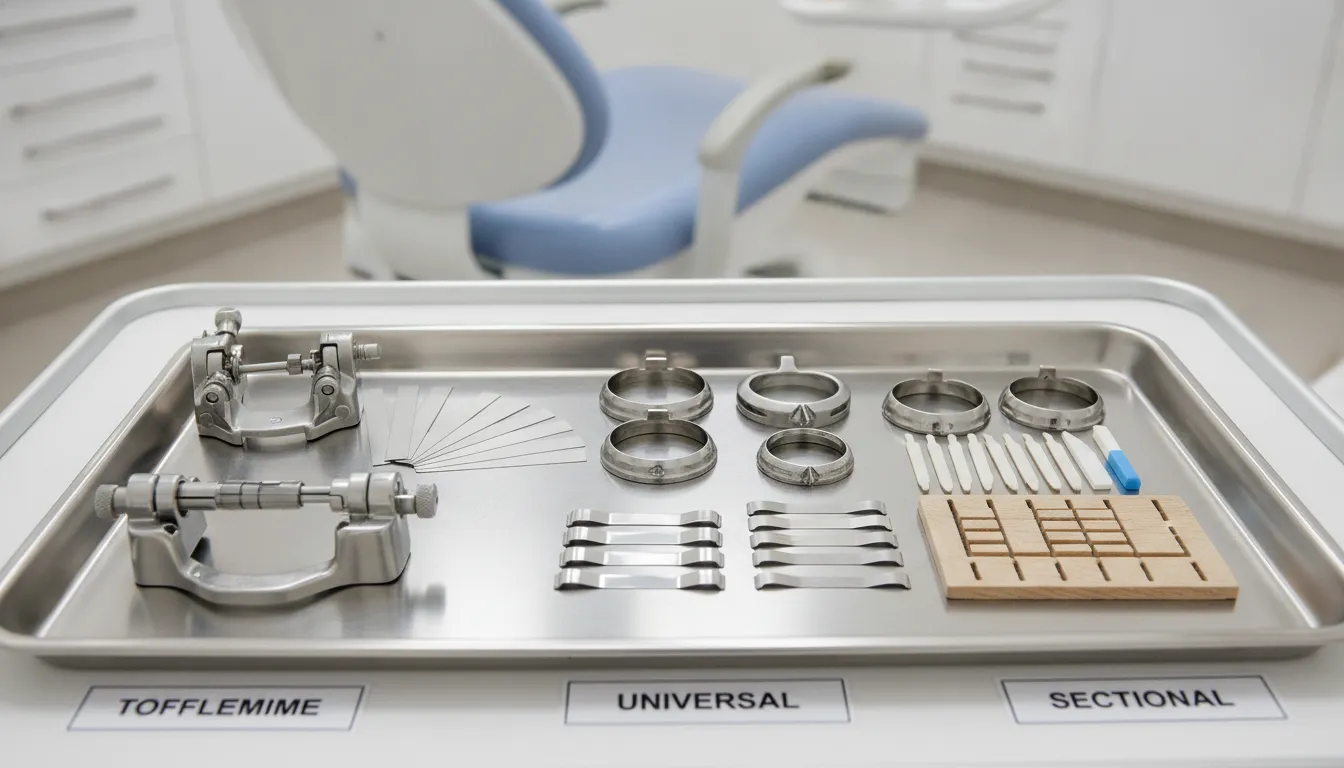
Sectional matrix retainers take a different approach from circumferential systems. Instead of wrapping a band fully around the tooth, these systems use a small, curved metal piece that covers only the missing wall of the tooth. A separation ring is placed between the teeth to open the contact point slightly. This method is especially popular with composite filling materials.
Research from the National Institutes of Health found that sectional matrix systems produce significantly tighter proximal contacts than circumferential systems. The separation ring generates a force that slightly separates the teeth during filling. When the ring is removed, the teeth move back together, creating a naturally tight contact point. This technique is particularly useful for dentists who place a high volume of posterior composite restorations and need predictable, repeatable results.
Sectional systems work best for single-surface Class II composites. They are less suitable for MOD restorations or cases where more than one proximal surface needs restoration at the same time. Many clinicians keep both circumferential and sectional systems on hand to match the system to each clinical situation. The Matrix Systems collection at SurgiMac includes options for both approaches.
Retainerless Matrix Systems
Retainerless matrix systems eliminate the handle and locking mechanism entirely, using bands with built-in tension features or self-locking designs. These systems reduce intraoral hardware, improve posterior access, and speed up setup time in high-volume practices.
Retainerless matrix systems are a newer category designed to simplify the matrix placement process. These systems eliminate the handle and locking mechanism found on traditional retainers. Instead, the band itself contains the tensioning feature, often through a built-in locking tab or a self-tensioning design.
The main advantage of retainerless systems is reduced bulk in the mouth. Without a retainer handle, the dentist has better access to the working area and improved visual clarity. This design also speeds up the setup process because there are fewer parts to assemble and adjust. For high-volume clinics, this time savings can add up significantly over the course of a day.
Retainerless systems are particularly well-suited for posterior teeth where access is already limited by cheek retraction and patient opening. The streamlined design also reduces the number of instruments that need to be sterilized between patients. However, clinicians should note that retainerless systems often have less tension control than traditional screw-type retainers, which may affect adaptation in irregularly shaped preparations. Review the Matrix Retainers collection for current retainerless product options.
How to Choose the Right Matrix Retainer Type
Choosing the right matrix retainer type depends on the restoration type, tooth location, and filling material. Tofflemire systems suit amalgam and large posterior defects. Sectional systems excel with composites and tight contacts. Universal retainers offer flexibility for irregular cases. Retainerless systems prioritize speed and access.
Selecting the right matrix retainer depends on several clinical factors. The table below compares the four main types across the dimensions that matter most in daily practice.
| Factor | Tofflemire-Style | Universal | Sectional | Retainerless |
|---|---|---|---|---|
| Best for | Class II amalgam, MOD defects | Irregular crown shapes, limited access | Posterior composites, single-surface | High-volume, fast setup |
| Band type | Circumferential metal band | Circumferential, multi-brand compatible | Partial band + separation ring | Self-tensioning band |
| Contact quality | Good with proper wedging | Good with proper wedging | Excellent (superior per research) | Good, less control than screw-type |
| Learning curve | Low | Low to moderate | Moderate | Low |
| Setup time | Moderate | Moderate | Quick for single surface | Fastest |
| Intraoral bulk | Moderate | Moderate | Low | Lowest |
| Ideal practice type | Amalgam and large posterior defects | Mixed restorative workflows | Composite-focused practices | Speed-oriented clinics |
When deciding, start with the filling material. For amalgam, a circumferential system such as the Tofflemire or universal retainer provides the seal and stability you need. For composite materials, a sectional system often delivers better proximal contacts. Also consider tooth position. Posterior molars typically work well with circumferential systems, while premolars and single-surface lesions may benefit from sectional approaches.
Many experienced clinicians keep all four types in their practice and select based on the specific case. Having a well-stocked inventory from the Matrix Systems collection ensures you are ready for any restorative situation that walks through the door.
Matrix Retainer Maintenance and Care
Proper maintenance of matrix retainers includes immediate rinsing after use, ultrasonic cleaning, autoclave sterilization. Periodic lubrication of screw mechanisms, and regular inspection for wear or damage to teeth and locking surfaces.
Matrix retainers are reusable instruments that need proper care to maintain their performance and lifespan. This section covers the essential steps for keeping your retainers in top condition.
Cleaning and sterilization protocols
After each use, rinse the retainer immediately to remove blood, saliva, and dental materials. Dried composite or amalgam residue can damage the locking mechanism over time. Follow with ultrasonic cleaning using an enzymatic solution for 10 to 15 minutes. Rinse thoroughly with distilled water before sterilization.
Autoclave sterilization at 134 degrees Celsius for 4 minutes is the standard for stainless steel retainers. Always follow the manufacturer instructions for cycle parameters. Place retainers in a sterilization pouch or cassette to protect the moving parts during the cycle. Allow them to dry completely before storage to prevent corrosion.
Lubrication and inspection
The screw mechanism on Tofflemire and universal retainers requires periodic lubrication. Apply a small drop of instrument lubricant to the screw threads and work it in by turning the knob through its full range of motion. Wipe away excess lubricant before sterilization. Lubricate weekly in high-use environments.
Inspect each retainer before every use. Check that the locking pin engages properly and the band tightens evenly when the knob is turned. Look for signs of wear on the guide slots and the locking surfaces. Replace any retainer that shows visible damage, rust, or compromised function. A failed retainer during a procedure creates unnecessary chair time and patient discomfort.
Store retainers in a dedicated instrument tray or cassette with individual slots. Avoid stacking retainers on top of each other, as this can bend the frame or damage the guide slots. Proper storage extends the lifespan of these instruments and ensures consistent performance.
Frequently Asked Questions
Find quick answers to common questions about matrix retainer selection, compatibility, and clinical use to support your restorative decision-making.
What is the most common type of matrix retainer? The Tofflemire-style matrix retainer is the most common type used in restorative dentistry. It is a circumferential system that works with metal bands for Class II restorations, particularly for amalgam fillings and large posterior defects.
Can you use a sectional matrix with any composite material? Yes, sectional matrix systems are compatible with all major composite resin materials. They are specifically designed for posterior composite restorations and work with both bulk-fill and conventional layering techniques.
How do you know which matrix band size to use? Matrix band size is determined by the tooth being restored. Universal and senior sizes fit most adult molars, while junior sizes are better for premolars, primary teeth, or short clinical crowns. Preformed anatomical bands offer seven different shapes to match specific tooth anatomy.
Are retainerless matrix systems as effective as traditional retainers? Retainerless systems are effective for many routine posterior composite restorations and offer advantages in speed and reduced intraoral bulk. However, they provide less tension control than screw-type systems, making them less suitable for irregular preparations or large MOD defects where precise band adaptation is critical.
Can a universal retainer replace a Tofflemire retainer? Universal retainers can serve as a replacement for Tofflemire retainers in most cases, offering additional adjustability for irregular tooth positions. However, some clinicians prefer the fixed-angle design of the Tofflemire for standard Class II restorations because it provides consistent, predictable band placement without requiring adjustment.
Ready to find the best matrix retainer for your dental clinic?
Choosing the right matrix retainer is a practical decision that affects your restoration quality, procedure speed, and patient outcomes. Whether you prefer the proven reliability of a Tofflemire system, the flexibility of a universal retainer. The contact quality of sectional systems, or the speed of a retainerless design, SurgiMac carries the options your practice needs.
Tags
Blog posts
-

, by SurgiMac A Clinician's Guide to Absorbable Suture Material
-
, by SurgiMac A Clinician's Guide to Dental Composite Resin Kits
-

, by SurgiMac How to Disinfect with Metrex CaviWipes Correctly
