
Mayo Hegar Needle Holder Description and Suture Use
- , by SurgiMac
- 17 min reading time
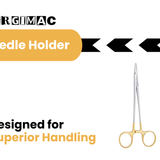
A thorough Mayo Hegar needle holder description covering its design, jaw types, sizes, ratchet mechanism, and use in wound closure and oral surgery.
Reliable needle control is fundamental to consistent wound closure. The instrument must hold a curved needle securely, support deliberate rotation through tissue, and release it without compromising suture placement. Those requirements matter in oral surgery as much as they do in broader surgical procedures, where access, tissue handling, and needle selection can vary.
A mayo hegar needle holder description centers on a stainless-steel needle driver with opposing jaws, ring handles, and a ratcheted locking mechanism. Textured jaw surfaces help maintain grip and reduce slipping, while some models use replaceable tungsten-carbide inserts for more precise handling and longer service life. Its robust construction supports controlled needle manipulation during wound closure and dental procedures.
Understanding how those components work together makes it easier to select the appropriate length, jaw construction, and locking feel for the procedure. The instrument's basic anatomy is the right place to begin.
Browse SurgiMac's professional surgical instruments
What Is a Mayo-Hegar Needle Holder?
A Mayo-Hegar needle holder is a ratcheted stainless-steel instrument, also called a needle driver, designed to grasp and maneuver curved suture needles during tissue closure. Its locking mechanism maintains a controlled hold while the clinician advances the needle through tissue. This makes it useful when consistent needle orientation and secure handling are more important than simply holding an instrument between the fingers. A Mayo-Hegar needle holder is commonly associated with medium-to-heavy suturing and is used across surgical and dental procedures, including wound closure and oral surgery.
The instrument's robust construction supports repeated needle manipulation in clinical settings. In dentistry, it can help clinicians manage sutures in oral and outpatient procedures where access may be limited and soft-tissue handling must remain precise. The same basic design is also used in general surgery, gynecology, plastic surgery, and other procedures involving wound closure. The Mayo-Hegar pattern is therefore a versatile needle driver rather than a tool limited to one specialty.
Core anatomy of the instrument
A Mayo-Hegar needle holder has four functional areas that work together:
- Jaws: The opposing tips contact the suture needle. Their length, profile, and surface texture determine how securely the needle is held. Textured jaw surfaces improve grip and help limit needle slippage during suturing. A review of surgical instruments describes these gripping patterns and their role in precise needle control.
- Box lock: This joint connects the two halves of the instrument and allows the jaws to open and close in alignment. A well-made box lock supports smooth movement and helps keep the jaws properly opposed.
- Ratchets: The interlocking teeth near the handles let the operator set and maintain the desired jaw pressure. The ratchet can secure the needle without requiring continuous squeezing, while releasing the lock allows controlled repositioning.
- Ring handles: The finger rings provide a stable grip and allow the clinician to open, close, lock, and release the instrument with familiar hand movements. They also support controlled wrist rotation as the curved needle follows its intended path through tissue.
Materials and needle control
Most Mayo-Hegar needle holders are manufactured from surgical stainless steel. Some models use replaceable tungsten carbide inserts in the jaws. These inserts can provide a more precise grip and greater wear resistance than stainless steel alone, which may be valuable in a busy dental or oral-surgery practice. Selection should match the needle size, suture material, tissue access, and expected procedural load.
In practical use, the needle is typically secured in the jaw area rather than at its sharp point. This positioning gives the operator a better balance of control and rotation while reducing the chance of compromising the needle. The instrument's box lock, ratchet, and ring handles then work as a single system to support reliable needle placement and release during wound closure.
A Complete Mayo-Hegar Needle Holder Description
A Mayo-Hegar needle holder combines a controlled jaw, locking ratchet, ring handles, and a box lock in a robust stainless-steel instrument. Each feature contributes to predictable needle handling during wound closure and oral surgical procedures. For clinicians evaluating an instrument, the important question is not simply whether it holds a needle. But whether it maintains a stable, precise grip throughout loading, tissue passage, and release.
Textured jaws and tungsten-carbide inserts
The jaws contain textured gripping surfaces that engage the needle and help prevent slipping during suturing. According to a surgical-instrument review from the National Center for Biotechnology Information, these patterns may be etched directly into stainless steel or applied to a replaceable tungsten-carbide insert. Tungsten-carbide inserts provide a more precise grip and wear considerably more slowly than stainless steel alone, supporting consistent performance over repeated clinical use. Review the cited needle-holder design reference.
That distinction matters when the holder is used with curved needles or sutures that require controlled changes in direction. The textured surface should secure the needle without unnecessary force. Excessive squeezing can deform a needle or reduce tactile control, while an inconsistent jaw surface can allow rotation at the moment precision is most important. Replaceable inserts also offer a practical maintenance advantage because the gripping component can be renewed rather than requiring immediate replacement of the entire instrument.
Ratchet, ring handles, and box-lock construction
The ratchet mechanism provides adjustable locking positions, allowing the clinician to secure the needle with a controlled amount of handle closure. A ratcheted Mayo-Hegar design is particularly useful when a stable grip must be maintained during manipulation of curved needles and medium-to-heavy suturing. The lock should engage cleanly and release without hesitation so the operator can adjust grip pressure rather than relying on continuous hand strength. See the practical Mayo-Hegar component reference.
Ring handles support a familiar, stable hand position and allow force to be applied through the instrument's axis. The box lock joins the handles and jaws while helping preserve alignment during closure. Together, the ring handles and box lock support stable force transmission, which can make needle rotation and advancement more predictable than manipulation with a non-locking grasping tool. Proper alignment, smooth movement, and a secure ratchet are essential inspection points before clinical use.
For clinicians comparing ergonomic options, SurgiMac's Air Series ergonomic precision instruments reflect the same focus on controlled handling and instrument feel. A complete Mayo-Hegar needle holder description should therefore include both visible anatomy and functional performance: textured or replaceable carbide gripping surfaces. Dependable ratchet engagement, stable ring handles, and a properly aligned box lock.
Mayo-Hegar Needle Holder Sizes and How to Choose
Mayo-Hegar needle holders are available in several shaft lengths, and the right size should match the operative field rather than simply the largest instrument available. Common options include approximately 15 cm, 17 cm, and 18 cm or longer. A 15 cm Mayo-Hegar needle holder is often a practical choice for superficial to intermediate-depth procedures because it balances reach with responsive control. Longer shafts can provide useful access when the working field is deeper, including procedures that require greater reach into a confined or visceral area.
Length affects leverage, visibility, and hand position. A shorter instrument generally gives the clinician a more direct sense of the needle and tissue. Which can support precise placement during routine wound closure or oral surgical procedures. A longer instrument keeps the hand farther from the field and may improve access when the incision or operative site is deep. However, excessive length can make fine manipulation less intuitive if the procedure does not require it. The most suitable option is the shortest needle holder that provides adequate access without forcing the hand into the sterile field or obstructing visualization.
Match the length to surgical access
Start by considering the depth and geometry of the surgical site. For superficial closure, dental soft-tissue repair, and other readily accessible fields, a 15 cm model may provide a useful combination of stability and maneuverability. A 17 cm instrument can offer additional reach while remaining suitable for general-purpose clinical use. Choose an 18 cm or longer shaft when the tissue plane is deeper. The incision is difficult to approach directly, or the clinician needs to maintain more distance from the operative site. These are practical selection ranges, not rigid rules. The needle holder should remain comfortable to control throughout the full closure.
Match the jaws to the needle and suture
Needle size and suture construction also influence selection. The jaws must hold the needle securely without crushing or distorting it. Textured jaw surfaces are designed to improve grip and reduce slippage during needle manipulation. Some instruments use replaceable tungsten carbide inserts, which provide a precise gripping surface and can offer greater wear resistance than stainless steel alone. Select the jaw pattern and working length that allow the needle to be loaded, rotated, and released without excess force. A ratcheted mechanism should secure the needle consistently while still allowing controlled release.
For a clear view of available specifications, review the Mayo-Hegar needle holder before ordering. Compare the listed length, jaw construction, and intended clinical use with the needles and suture materials used in your practice. This approach supports consistent instrument selection across dental and surgical teams, while preserving the precision needed for reliable tissue approximation.
How to Use a Mayo-Hegar Needle Holder for Wound Closure
Correct handling of a Mayo-Hegar needle holder supports controlled needle placement, consistent suture tension, and atraumatic tissue approximation. The ratchet should secure the needle firmly without crushing it, while the wrist and forearm guide the needle along its natural curvature. Select an appropriate suture and needle for the tissue, procedure, and closure plan, such as a suitable option from premium surgical sutures. Follow the facility's established aseptic and tissue-handling protocols throughout the procedure.
- Position the needle holder. Hold the ring handles with the thumb and ring finger, allowing the index finger to guide the instrument near the box lock. Keep the jaws aligned with the intended needle entry point and maintain a clear view of the needle and tissue.
- Load the curved needle in the jaws. Open the jaws and place the needle between them, near the distal portion of the jaws rather than at the hinge. Align the needle so its curve can follow the planned path through the tissue. Avoid grasping the sharp point or the swaged suture connection.
- Grasp the needle at the control point. Secure the needle approximately one-half to one-third of the distance from its sharp end, as recommended for controlled handling of a curved needle. This position provides leverage while preserving the needle's curvature. Apply enough pressure for a stable grip, but do not over-compress the needle, which can deform or weaken it.
- Engage the ratchet. Close the handles until the ratchet locks at the setting that provides a secure hold without excessive force. Confirm that the needle does not rotate or slip when gently tested. A properly engaged ratchet allows the instrument to maintain the grip while the operator advances the needle through tissue.
- Drive the needle through tissue with wrist motion. Enter at the planned distance from the wound edge and follow the needle's curve through the tissue. Use a controlled wrist rotation, typically supination as the needle exits, rather than pulling the needle straight through with the fingers or bending it against the tissue. Match the depth and bite on the opposite side when clinically appropriate, while avoiding unnecessary tissue trauma.
- Release and re-grasp for the next pass. Once the needle has emerged far enough to continue the suture path, release the ratchet and open the jaws. Re-grasp the needle closer to the rear portion, away from the point and suture attachment, then advance it for the next pass. Releasing and repositioning preserves instrument control and avoids dragging the needle through tissue.
- Complete the pass and assess the closure. Pull the suture through without excessive tension, then inspect tissue approximation, wound-edge eversion, hemostasis, and the absence of strangulation. Repeat the loading, grasping, rotation, release, and re-grasp sequence for subsequent throws according to the selected closure technique.
Needle control depends on instrument condition as well as technique. If the jaws fail to align, the ratchet does not hold, or the needle slips despite appropriate handling. Remove the instrument from use and follow the facility's inspection and maintenance process before continuing.
Mayo-Hegar vs. Other Needle Holders: What to Know
Needle holder selection should match the needle profile, suture material, tissue depth, and degree of control required during closure. A Mayo-Hegar is a robust needle driver with a ratcheting lock and textured or insert-lined jaws. That combination makes it a practical choice for medium-to-heavy suturing, where the instrument must maintain a secure grip on a curved needle without excessive hand pressure. Needle holders are commonly made from stainless steel, and textured jaw surfaces help reduce needle slippage during manipulation (review of surgical instruments).
Other designs can be more efficient in narrower clinical situations. Crile-Wood holders are lighter and better suited to fine needles. Olsen-Hegar instruments combine needle-holding jaws with integrated suture scissors, which can reduce instrument exchanges during closure. Castroviejo holders use a spring-loaded handle and are designed for delicate, highly controlled work, including microsurgery. The comparison below summarizes the functional differences.
| Instrument | Jaw or insert | Locking mechanism | Best use |
|---|---|---|---|
| Mayo-Hegar | Short, sturdy jaws with textured surfaces or optional tungsten carbide inserts for a stable needle grip | Finger-ring handles with a ratchet lock | Medium-to-heavy suturing, including routine surgical and dental wound closure |
| Crile-Wood | Slender, finer jaws designed for smaller needles and more delicate handling | Finger-ring handles with a ratchet lock | Fine sutures and tissue closure where a lighter instrument is advantageous |
| Olsen-Hegar | Needle-holding jaws combined with an integrated suture-cutting blade | Finger-ring handles with a ratchet lock | Closures that benefit from holding and cutting suture with one instrument |
| Castroviejo | Fine, narrow jaws intended for precise control of small needles | Spring-loaded handle, generally without a conventional ring-and-ratchet grip | Microsurgery and other delicate procedures requiring refined needle positioning |
For routine oral surgery or heavier closure materials, the Mayo-Hegar design offers a dependable balance of grip strength and control. A Mayo-Hegar needle holder with suitable jaw length and insert configuration can support consistent handling across clinical cases. Choose a finer Crile-Wood or Castroviejo pattern when the needle and tissue demand greater delicacy, and consider Olsen-Hegar when integrated cutting capability will improve procedural efficiency.
How to Care for and Sterilize Your Mayo-Hegar Needle Holder
Consistent reprocessing protects patients, preserves needle control, and extends the service life of a Mayo-Hegar needle holder. Treat the instrument as a precision device rather than leaving it assembled with dried blood or tissue in the box lock. Follow your facility's validated instrument-reprocessing protocol and the manufacturer's instructions for the specific stainless-steel or tungsten-carbide model.
Clean promptly after use
At the point of use, remove gross soil before it dries. Keep the holder moist according to your facility's approved process, then open the ratchet fully so cleaning solution can reach the jaws, serrations, hinge, and box lock. Use a soft instrument brush and a compatible detergent. Avoid abrasive pads, metal brushes, and harsh chemicals that can scratch stainless steel or damage tungsten-carbide inserts. Do not force debris through the box lock with a sharp object.
After cleaning, rinse thoroughly with the water quality specified by your reprocessing department and dry every surface. Residual detergent, moisture, or bioburden can interfere with sterilization and contribute to staining or corrosion. Inspect the instrument under good lighting before packaging. If soil remains around the hinge or inside the box lock, return it for additional cleaning rather than sterilizing it as-is.
Use a validated sterilization cycle
Package the holder in the open position, with the ratchet disengaged, unless the device instructions specify otherwise. This allows steam or sterilant to contact the working surfaces and reduces stress on the mechanism. Stainless-steel Mayo-Hegar needle holders and models with tungsten-carbide jaw inserts may be processed in the same general sterilization system when the manufacturer permits it. But the validated cycle, load configuration, and drying requirements still govern. Never select a cycle based only on the instrument's appearance or material.
For broader guidance, review SurgiMac's sterilization of dental instruments resource and follow your clinic's infection-prevention policy. After the cycle, allow the package to dry and cool before handling. Wet packs should be treated according to facility protocol, not stored or used as sterile.
Inspect the mechanism and jaw inserts
Before each use, test the ratchet for secure engagement and smooth release. Check that the jaws meet evenly, the box lock is aligned, and the ring handles move without excessive looseness or binding. The jaws should hold the intended needle without rocking, slipping, or crushing it. Do not lubricate with household oil. Use only an instrument lubricant approved for the sterilization method and compatible with the device.
Tungsten-carbide inserts are replaceable, but they are not permanent. Replacement is indicated when inserts are chipped, loose, visibly worn, misaligned, or no longer provide a consistent atraumatic grip despite proper cleaning. Remove damaged instruments from service and have repairs or insert replacement performed by an authorized service provider. For sourcing replacement-ready needle holders and related devices, browse SurgiMac's surgical instruments collection.
Shop premium MacSuture surgical sutures
Frequently Asked Questions
What is a Mayo-Hegar needle holder used for?
A Mayo-Hegar needle holder securely grasps and maneuvers a curved suturing needle during wound closure and tissue suturing. Its locking grip supports controlled needle placement in dental, oral-surgical, and other surgical procedures. Needle holders are also called needle drivers, according to the National Center for Biotechnology Information review.
What are the basic parts of a Mayo-Hegar needle holder?
The main components are the jaws, box-lock joint, ratchet, and ring handles. The jaws contact the needle, while the box lock supports instrument alignment and the ratchet maintains the selected grip. Textured jaw surfaces help reduce needle slippage during suturing.
How is a Mayo-Hegar different from other needle holders?
A Mayo-Hegar uses a robust, ratcheted design for a secure grip and is commonly selected for medium-to-heavy suturing. A Castroviejo typically uses a slimmer, spring-handled format for delicate work, while an Olsen-Hegar combines a needle holder with scissors. The best choice depends on needle size, suture material, access, and the required level of control.
Are tungsten carbide Mayo-Hegar needle holders worth considering?
They can be useful in demanding clinical settings. Replaceable tungsten carbide jaw inserts provide a precise grip and generally wear more slowly than stainless steel jaw surfaces, as described in the cited NCBI review. Inspect the inserts regularly and replace the instrument or inserts when grip quality declines.
How do I choose the right Mayo-Hegar size?
Choose a length that gives adequate access without sacrificing tactile control. A shorter holder often suits superficial oral procedures, while a longer holder can help when the closure site is deeper or access is limited. Match the jaw pattern and working length to the needle and suture, then confirm that the ratchet closes smoothly without crushing the needle.
Get Started With the Right Needle Holder
Reliable needle control supports consistent technique during wound closure and oral surgery. SurgiMac makes it easier to source a Mayo-Hegar needle holder suited to professional clinical use, along with compatible sutures for procedural needs. Browse the Mayo-Hegar needle holder and take the next step toward a dependable instrument setup.
Tags
Blog posts
-
, by SurgiMac A Clinician's Guide to Absorbable Suture Material
-
, by SurgiMac A Clinician's Guide to Dental Composite Resin Kits
-
, by SurgiMac How to Disinfect with Metrex CaviWipes Correctly
