
Reducing Hand Fatigue With Hollow Handle Scalers
- , by SurgiMac
- 15 min reading time
Learn how reducing hand fatigue with hollow handle scalers starts with handle fit, balance, technique, maintenance, and workflow reviews for dental teams.
Hand fatigue during scaling is rarely explained by one feature alone. Handle diameter, instrument mass, balance, grip security, tip geometry, and the way an instrument is used all shape the force and control required during a procedure. For U.S. dental professionals, the goal is not to identify a handle that promises to prevent injury. The goal is to select a periodontal scaler that supports efficient technique and a comfortable, repeatable workflow.
Reducing hand fatigue with hollow handle scalers starts with evaluating lower mass and balance alongside diameter, tactile feedback, and grip control. A hollow handle may reduce instrument mass, but it is only one part of an ergonomic selection decision.
Evidence from simulated scaling research suggests that handle shape can influence pinch force and hand muscle load. Later testing found that diameter may affect clinician preference more than weight alone. Those distinctions provide a useful basis for examining why handle design matters during scaling.
Review SurgiMac Air Series dental instruments for ergonomic handling options
Why handle design matters during scaling
Hand fatigue during periodontal scaling is not only a question of how hard a clinician works. The handle can change how much force is required to maintain control. A CDC/NIOSH-hosted study identifies forceful pinching during dental scaling as an important occupational risk factor and found that handle design significantly affected hand muscle load and pinch force.
That study involved 24 dentists and dental hygienists using 10 custom-designed scaling instruments with different diameters and weights. Researchers measured forearm muscle activity with electromyography and thumb pinch force with pressure sensors. In the simulated task, the 10 mm diameter, 15 g instrument required the least muscle load and pinch force. The researchers also reported that diameters larger than 10 mm did not provide additional benefit in that experiment.
These findings help explain why a hollow handle may be worth evaluating during instrument selection. Reducing mass can affect balance and handling, but a lighter instrument is not automatically the best instrument for every clinician or procedure. Diameter, grip security, tip geometry, and tactile feedback still influence whether the clinician can maintain a controlled modified pen grasp without unnecessary squeezing.
The evidence also argues against choosing a handle by weight alone. In a simulated study of 27 dental hygienists, four handles ranged from 16 to 23 g and from 6.35 to 12.7 mm in diameter. The 23 g, 11.1 mm handle produced significantly more overall mean muscle activity than the other three designs. Muscle activity was similar for the 16, 18, and 21 g instruments. Most participants preferred the 16 g, 12.7 mm design. The full findings are available through PubMed.
For dental teams, the practical takeaway is to compare handle diameter, mass, and balance with the intended scaling task and each clinician's hand. These simulations do not prove that a particular hollow-handle scaler prevents injury. The study authors specifically called for more research connecting handle-related muscle load with real-world musculoskeletal risk. Use the evidence as a selection guide, then assess control, tactile feedback, and comfort during representative clinical work.
How to choose hollow handle scalers for your team
Hollow construction can reduce mass and influence balance, but it is only one selection factor. A scaler that feels light in a catalog may still encourage excessive pinch force if its diameter, surface, or working end does not suit the clinician. Evaluate each instrument in the grasp and clinical positions your team uses most often.
| Criteria | What to assess | Why it matters in practice |
|---|---|---|
| Handle diameter | Compare a larger, comfortable diameter with the clinician's hand size and modified pen grasp. Avoid assuming that the largest option is best. | Research on dental instrument handles suggests that diameter can affect muscle load and pinch force. One simulated study found no additional benefit above 10 mm, so individual fit remains important. Review the handle-design evidence. |
| Mass and balance | Check total mass, where the weight sits, and whether the instrument remains stable during controlled activation. | A hollow handle may lower mass, but lighter is not automatically better if balance feels unstable. The team should compare instruments by controlled trial rather than construction label alone. |
| Grip surface | Look for a secure, non-slippery surface that supports a light grasp without sharp edges, excessive ridges, or pressure points. | Grip security can reduce the need to pinch harder, especially when gloves or moisture change the hand-to-instrument interface. |
| Shank and tip geometry | Match terminal shank angulation, tip shape, and working-end access to anterior or posterior surfaces and the calculus being removed. | A comfortable handle cannot compensate for a poorly matched working end. Use this guide to selecting the right scaling instrument when comparing scaler and curette indications. |
| Tactile feedback | Assess whether the clinician can detect surface changes and calculus while maintaining a relaxed wrist and stable fulcrum. | Feedback depends on the complete instrument system, including handle, shank, tip, and technique. Do not treat hollow construction as proof of superior sensitivity. |
| Reprocessing compatibility | Confirm the manufacturer's instructions for cleaning, packaging, sterilization, inspection, and replacement before standardizing a model. | Do not infer autoclavability from a hollow design. The instrument must fit your validated reprocessing workflow and remain intact after repeated cycles. |
For team trials, let clinicians compare several handle profiles during representative procedures and record comfort, control, access, and post-session fatigue. SurgiMac's Air Series dental instruments can be one collection to review when lightweight handling and ergonomic form are priorities. Select the model that supports precise scaling with the least unnecessary grip effort, not simply the one marketed as hollow.
Reducing hand fatigue with hollow handle scalers in practice
A hollow handle can support a lighter, balanced instrument, but the clinician's technique and workflow still determine how much force is used during scaling. Treat the handle as one part of an ergonomic system rather than a substitute for positioning, instrument maintenance, or task variation.
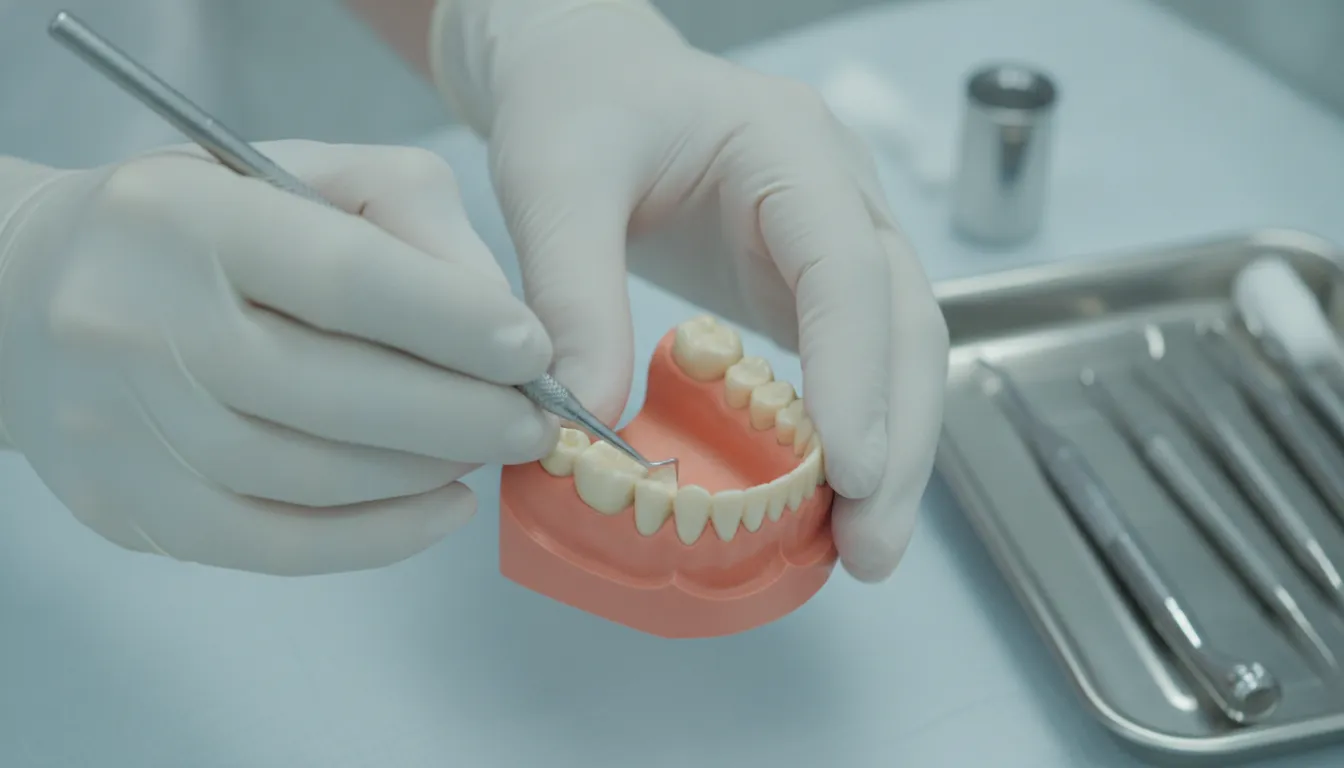
The following sequence keeps the focus on controlled force and repeatable movement. It is a practical workflow, not a diagnosis or a guarantee of preventing discomfort.
- Set a neutral wrist. Position the patient, chair, light, and clinician seat so the wrist stays close to neutral while the working end reaches the treatment area. Avoid bending the wrist to compensate for limited access. Reposition the patient or your upper body when the line of sight changes.
- Use a light modified pen grasp. Hold the scaler securely without squeezing the handle. A larger, lightweight handle may reduce the need for forceful pinching, but diameter and balance should match the clinician's hand and the procedure. Handle design has been shown to affect muscle load and pinch force in simulated scaling tasks. Although laboratory findings do not establish a universal best instrument for every clinician.
- Build a stable fulcrum. Establish a secure intraoral or extraoral finger rest before activating the working stroke. A stable fulcrum helps direct movement from the fingers and hand instead of relying on excessive wrist motion or grip pressure.
- Keep strokes controlled. Use short, deliberate strokes appropriate to the surface and deposit. Let the terminal shank and working end maintain the intended adaptation. If access or visibility is poor, pause and reposition rather than increasing force.
- Rotate the instrument deliberately. Roll the handle between the fingers as needed to maintain the correct working-end relationship. Avoid twisting the wrist repeatedly to recover adaptation. Instrument rotation should be smooth and limited to what the surface requires.
- Vary tasks and take microbreaks. Alternate demanding procedures or hand-intensive tasks when scheduling permits. Brief pauses to release the grasp, move the fingers, and reset posture can help prevent continuous loading. Resume only when the working position is organized.
- Maintain the working end. Inspect sharpness and tip condition according to the practice protocol. A dull or damaged scaler may encourage added pressure and repeated strokes. Sharpen or replace the instrument when indicated, and follow the manufacturer's instructions for cleaning and instrument reprocessing.
Document which handle diameter, mass, and grip surface work best for each clinician and procedure. That practical feedback can guide future instrument selection without assuming that one hollow-handle design fits every hand or access challenge.
Which scaler design fits anterior and posterior access?
Choose a scaler by the surface and deposit you need to reach, not by handle construction alone. Anterior teeth generally allow more direct visual and finger access, while posterior teeth can require greater adaptation around line angles, proximal surfaces, and limited working space. The instrument should support a stable fulcrum and controlled activation without forcing the wrist or fingers into an awkward position.
Sickle scalers for supragingival deposits
A sickle scaler has a pointed tip and triangular cross-section. It is typically selected for supragingival calculus, particularly when a strong cutting edge is useful for disrupting tenacious deposits. The pointed design can be effective around anterior lingual surfaces and interproximal areas, but it requires careful adaptation. Keep the lateral surface against the tooth and avoid directing the tip into soft tissue.
Universal scalers for broader access
A universal scaler offers a different balance of access and versatility. Its working end can be adapted to multiple tooth surfaces, including posterior areas, when the clinician selects the correct terminal shank and maintains the appropriate face-to-tooth relationship. Angulation, visibility, patient opening, and the location of the deposit all matter more than a one-size-fits-all label.
For posterior access, compare the shank angle, terminal end, and tip geometry before choosing a hollow-handle instrument. A handle that feels light but requires excessive finger pressure or repeated repositioning may not reduce fatigue in actual use. Diameter and balance should also match the clinician's grasp. Research on dental instrument design has linked handle diameter and weight with muscle load and pinch force. But those findings do not identify one universally best scaler for every operator or surface.
Use the guide to selecting the right scaling instrument when deciding whether a scaler or curette better matches the deposit and access challenge. Then assess the candidate instrument in the working position: can you maintain a light modified pen grasp, a supported fulcrum, and short controlled strokes without losing tactile feedback? That practical check is central to reducing hand fatigue with hollow handle scalers.
How SurgiMac instrument lines support ergonomic selection
Instrument selection should begin with the clinician's hand, working posture, and procedure demands, not with a product label alone. A hollow handle may reduce mass and change balance, but the best fit still depends on diameter. Surface security, shank access, tip geometry, tactile feedback, and compatibility with the team's reprocessing workflow.
SurgiMac's Air Series dental instruments are positioned around lightweight construction, ergonomic handling, control, and balance. Those features make the collection relevant for teams comparing instruments intended to support a lighter modified pen grasp. Collection copy describes product positioning, not independent clinical proof, so each clinician should assess the instrument during representative scaling procedures.
The Slim Series instruments offer another selection path when a slimmer construction and tactile access are priorities. A narrow profile may feel more precise for some clinicians or improve access in specific areas, while another clinician may prefer a larger diameter that reduces pinch demand. Research on dental handles supports evaluating diameter and mass together rather than assuming that the lightest or slimmest option will suit every hand.
A practical trial checklist for dental teams
- Match the instrument to the procedure: Confirm that the scaler's working end, shank design, and terminal dimensions suit the anterior or posterior surfaces being treated.
- Compare fit across clinicians: Have each user test the same instrument during normal fulcrum placement, activation, and repositioning. Record grip security, tactile feedback, wrist position, and perceived pinch effort.
- Check balance and access: Assess whether the handle stays stable without excessive thumb pressure and whether its profile interferes with intraoral access or mirror positioning.
- Review maintenance requirements: Confirm compatibility with the practice's cleaning, packaging, sterilization, sharpening, and replacement procedures before standardizing a line.
- Evaluate over multiple sessions: A brief trial can identify immediate comfort issues, but team feedback across varied patients and appointment lengths provides a more useful purchasing decision.
Use clinician feedback to narrow the trial set, then compare performance with a consistent technique. The goal is not to promise that one collection prevents discomfort. It is to select dental instruments that support secure control, efficient access, and a sustainable workflow for the people who use them every day.
When hand fatigue signals a workflow review
Recurring hand fatigue is a useful prompt to examine the entire scaling workflow rather than assuming the handle alone is responsible. Start by noting when discomfort appears, which procedures or quadrants trigger it, and whether symptoms change with a different instrument. This simple observation can help identify a mismatch between instrument design, clinical access, and the demands of a scheduled appointment.
Review the instrument and its condition
Check whether the scaler is appropriate for the surface and access angle. A tip that is dull, damaged, or poorly matched to the task may encourage additional force or a tighter pinch. Confirm the handle diameter, mass, balance, grip security, and tactile feedback. A hollow handle may reduce mass, but it is not a substitute for a secure grasp and suitable tip geometry. The available evidence supports treating handle selection as one part of ergonomic decision-making, not as a guarantee against discomfort. Instrument reprocessing requirements and the manufacturer's maintenance guidance should also remain part of the selection review.
Assess positioning and scheduling
Observe wrist position, fulcrum support, patient positioning, operator seating, and the height and reach of the workstation. Small changes that improve visibility and access may reduce the need to bend the wrist or sustain a forceful pinch. During longer sessions, vary hand position and use brief, planned microbreaks when the schedule permits. Rotating suitable instruments and alternating demanding procedures may also help distribute workload across the day, provided clinical quality and infection-control protocols are maintained.
This review is an ergonomic screen, not a diagnosis or treatment plan. Persistent, worsening, or function-limiting pain, numbness, tingling, weakness, or other symptoms warrant evaluation by a qualified occupational health professional or appropriate clinician. A dental ergonomics specialist can also observe technique and workstation setup in context. The goal of reducing hand fatigue with hollow handle scalers is to make informed equipment and workflow choices while recognizing when professional guidance is needed.
Compare ergonomic Air Series dental instruments for your practice
Frequently Asked Questions
What handle features should I compare when selecting a hollow-handle scaler?
Compare diameter, overall mass, balance, grip security, shank and tip geometry, tactile feedback, and compatibility with your instrument-reprocessing workflow. A hollow handle may reduce mass. But the best choice is the one that lets you maintain a light modified pen grasp and controlled strokes without excessive pinch force.
What is the key difference between a dental curette and a hand scaler?
A scaler is generally designed for removing supragingival deposits, while a curette has a rounded toe and blade configuration intended for subgingival adaptation and root-surface instrumentation. Select the instrument according to deposit location, tooth anatomy, access, and the clinical procedure rather than choosing by handle comfort alone.
What is the best scaler for anterior teeth?
Choose a scaler with tip geometry and shank angulation that provide clear access to the anterior surfaces you are treating. A secure, appropriately sized handle can help you maintain control, but no single design is best for every clinician or patient. Evaluate adaptation, visibility, tactile feedback, and wrist neutrality during simulation or routine use.
When should hand fatigue prompt an instrument or workflow review?
Review the setup when fatigue recurs, increases during particular procedures, or leads you to tighten your grasp. Check instrument sharpness, handle diameter and balance, fulcrum support, workstation positioning, stroke length, rotation, scheduling, and microbreaks. Persistent discomfort should be discussed with qualified occupational or clinical guidance rather than treated as an instrument problem alone.
Ready to review ergonomic dental instruments?
Handle diameter, balance, and grip design can influence how a scaler feels during repeated clinical use. Review SurgiMac's ergonomic options to compare features that may support precise, controlled instrumentation and a workflow suited to your practice. To get started, review Air Series dental instruments and compare the available options for your professional team.
Tags
Blog posts
-
, by SurgiMac A Clinician's Guide to Absorbable Suture Material
-
, by SurgiMac A Clinician's Guide to Dental Composite Resin Kits
-
, by SurgiMac How to Disinfect with Metrex CaviWipes Correctly
