
Dental Elevator Types: A Complete Guide to Extraction Instruments
- , by SurgiMac
- 16 min reading time
son">{"@Schedule your surgical instrument consultation today. Explore dental elevator types including straight, Cryer, luxator, and Apexo designs for atraumatic...
Dental elevators are precision surgical instruments that luxate teeth from their alveolar sockets prior to forceps delivery. Selecting the correct dental elevator types for a given root morphology reduces root fracture risk, preserves alveolar bone, and shortens operative time. The five main categories of dental elevators are straight elevators, Cryer elevators, Potts elevators, Apexo root tip picks, and luxators. Each applies distinct mechanical principles lever, wedge, and wheel-and-axle action suited to specific clinical scenarios.
Browse SurgiMac’s complete surgical instruments collection for premium dental elevators and extraction tools.
What Are Dental Elevators?
Dental elevators are hand-held surgical instruments designed to luxate teeth before extraction. Oral health conditions affect approximately 3.5 billion people worldwide per the World Health Organization, and tooth extraction remains one of the most common surgical interventions in dentistry. Elevators accomplish luxation by inserting a thin blade into the periodontal ligament space and applying controlled mechanical force to expand the socket and sever the suspensory fibers.
A dental elevator differs fundamentally from extraction forceps. Forceps grasp the crown and deliver a pulling force. Elevators, by contrast, apply lever, wedge, and rotational forces directly to the root surface. This distinction matters because uncontrolled pulling can fracture the crown or damage adjacent teeth, whereas the elevator’s targeted mechanical action disrupts the periodontal attachment with minimal collateral trauma. Research in oral surgery confirms that proper elevator use reduces intraoperative complications and supports faster healing.
Mechanical Principles in Oral Surgery
Three classical physics concepts govern elevator function:
- Lever action. The elevator tip acts against the alveolar bone or an adjacent root as a fulcrum. A force applied at the handle is amplified at the tip, prying the tooth coronally.
- Wedge action. The thin blade is driven into the periodontal ligament space. As the blade advances, the tapering shape displaces bone and root apart, expanding the socket.
- Wheel-and-axle action. Rotation of the handle produces a strong lifting torque at the tip. This mechanism is especially effective with curved elevators such as Cryer and Potts patterns.
Skilled clinicians combine these principles in sequence: wedge the blade into the PDL space. Rotate to seat the tip, then lever against the alveolar crest to elevate the root.
Why Instrument Selection Matters
Teeth vary widely in root count, curvature, bone density, and access angle. A straight elevator that performs well on a maxillary incisor is poorly suited to a mandibular molar with divergent roots. Using the wrong instrument increases the risk of root fracture, alveolar bone loss, and soft tissue trauma. Conversely, matching blade geometry to root morphology allows the surgeon to work efficiently with controlled force, preserving the extraction site for future implant placement when indicated.

Straight Elevators
The straight elevator is the most widely used extraction instrument in oral surgery. It features a straight or slightly concave blade aligned with the long axis of the handle, available in blade widths ranging from 2 mm to 6 mm. The straight design provides direct force transmission from handle to tip, making it the default choice for initial luxation of single-rooted teeth.
SurgiMac carries straight elevators in the Air Series with lightweight, ergonomic handles designed to reduce hand fatigue during extended procedures. The high-grade stainless steel blades maintain their edge and resist corrosion through repeated sterilization cycles.
Find the right straight dental elevator for your practice at SurgiMac today.
Straight elevators are indicated for:
- Maxillary incisors and canines with single conical roots
- Premolars with well-defined root morphology
- Initial luxation prior to forceps application in any arch
- Root tips accessible via a straight-line approach
The Air Series straight elevators feature black tin-tipped non-serrated blades that improve visual contrast against oral tissues, a design consideration that experienced clinicians value for precision work.
Cryer Elevators
Cryer elevators, also called flag elevators, have a distinctive triangular blade with a sharp point. They are manufactured in mirrored left and right pairs (31 and 32 patterns). The triangular cross-section and angled shank allow the surgeon to reach between divergent roots of mandibular molars and engage the inter-radicular bone septum as a fulcrum.
The primary indication for a Cryer elevator is elevation of the mesial or distal root of a mandibular molar after the crown has been sectioned. The tip is inserted into the furcation area, and the instrument is rotated so the triangular blade bears against the inter-radicular bone. The resulting lifting force delivers the root coronally along the path of least resistance.
SurgiMac’s 31/32 large Cryer elevators are manufactured from surgical-grade steel with precision-ground tips that maintain their geometry through years of clinical use. The lateral sets (left and right) allow the surgeon to approach either root from the optimal angle without twisting the wrist.
Potts Elevators
Potts elevators feature a curved, pointed blade set at an angle to the handle, designed for elevating roots from deep, narrow sockets. The curvature provides access to posterior segments where straight instruments cannot align with the root axis. Potts elevators are particularly useful for maxillary third molar root elevation and for delivering fractured root remnants from the apical third of the socket.
The blade curvature transfers rotational handle movement into a controlled lifting arc at the tip, requiring less wrist deviation than straight instruments. This mechanical advantage reduces surgeon fatigue during complex posterior extractions and improves tactile feedback at the blade tip.
Luxators and Periotomes
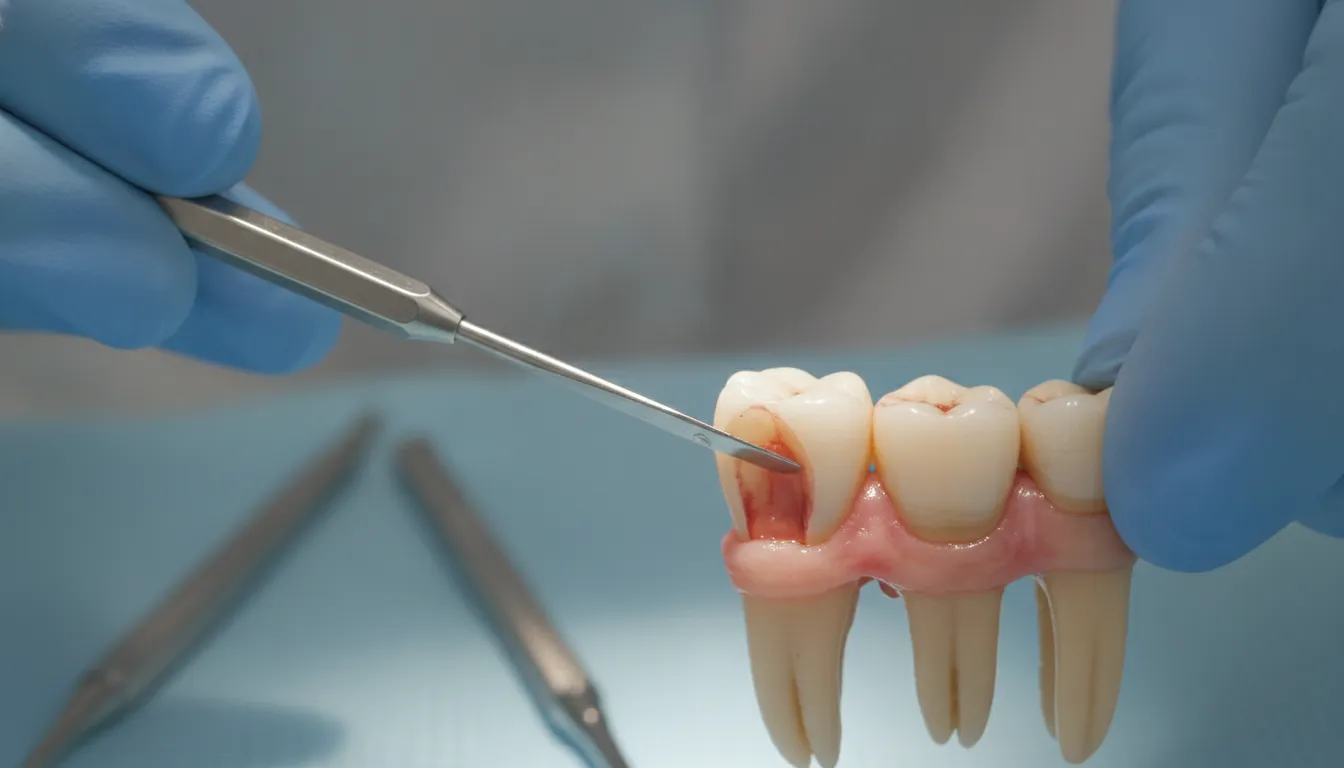
Luxators and periotomes represent a distinct category of atraumatic extraction instruments. Unlike standard elevators that rely primarily on lever and wedge action against bone. Luxators have exceptionally thin, sharp blades designed to cut the periodontal ligament fibers with a push-cut motion.
Luxator Technique
The luxator blade is inserted into the PDL space with gentle axial pressure and a slight cutting rotation. Once the blade reaches the apical third of the root, a controlled rotational movement severs the remaining fibers and begins socket expansion. The key distinction from conventional elevator use is that luxators should never be used as levers or pry bars; the thin blade will fracture under bending loads. Proper luxator technique relies on the sharp cutting edge and thin cross-section to accomplish fiber transection with minimal bone displacement.
SurgiMac offers luxating hybrid elevators that combine the thin PDL-cutting blade of a luxator with a reinforced shank capable of light rotational elevation. This hybrid design allows a single instrument to perform both ligament sectioning and initial luxation without changing tools.
Periotome Applications
Periotomes are even thinner than luxators, with blade thicknesses under 0.5 mm. They are used primarily in implant-focused practices where maximum bone preservation is the clinical priority. The periotome is inserted into the PDL space with a push-rotate motion that severs the fibers progressively from the coronal to apical extent. The thin profile minimizes alveolar bone displacement, preserving ridge volume for immediate or early implant placement.
Root Tip Picks and Apexo Elevators
Root tip picks, including Apexo elevators, are fine-tipped instruments designed for removing fractured root segments from the apical region of extraction sockets. These instruments have extremely narrow, sharp blades that can access the deepest portion of a socket without damaging the surrounding bone.
The Apexo elevator blade is inserted alongside the fractured root fragment and rotated, using the socket wall as a fulcrum. The fine tip concentrates force on a small area, lifting the fragment coronally. For optimal control in these delicate maneuvers, SurgiMac’s Slim Series and Air Series instruments provide the tactile feedback and narrow profile required for fine apical work.
Clinical guidance from the National Institutes of Health emphasizes that root tip retrieval should be performed with the narrowest possible instrument to conserve socket architecture. Apexo elevators and similar root tip picks fulfill this requirement by concentrating force delivery at the blade tip while keeping the instrument body diameter minimal.
Comparison of Dental Elevator Types
| Elevator Type | Blade Shape | Mechanical Principle | Primary Indication | Best Arch Application |
|---|---|---|---|---|
| Straight | Straight, concave | Wedge and lever | Initial luxation, single-rooted teeth | Maxillary anterior, premolars |
| Cryer | Triangular, pointed | Lever against inter-radicular bone | Mandibular molar root elevation | Mandibular posterior |
| Potts | Curved, pointed | Rotational lever | Deep socket root elevation | Maxillary posterior, third molars |
| Luxator | Very thin, sharp | PDL fiber cutting | Atraumatic extraction, ligament sectioning | Universal |
| Apexo / Root Pick | Fine, sharp point | Wedge against socket wall | Fractured root tip retrieval | Universal, deep sockets |
Selecting the Right Elevator by Root Morphology
Experienced oral surgeons evaluate three root characteristics before choosing an elevator: root count, root curvature, and bone density.
Single-Rooted Teeth
Maxillary incisors, canines, and most premolars have single, relatively straight roots. A straight elevator with a blade width matching the mesiodistal root diameter is the standard choice. The blade is inserted along the mesial or distal root surface with the concave face oriented coronally. Gentle rotational and levering movements expand the socket progressively.
For narrow or fragile roots, instruments from SurgiMac’s Slim Series provide a thinner blade that reduces the risk of root fracture during initial luxation. The improved tactile transmission of the Slim Series handle allows the surgeon to feel the ligament release rather than relying on visual cues alone.
Multi-Rooted Teeth
Mandibular molars with mesial and distal roots present the classic indication for Cryer elevators. After crown sectioning, the Cryer tip is placed in the furcation and rotated so the triangular blade engages the inter-radicular bone. This creates a controlled lifting force on the selected root. For maxillary molars with three roots, a Potts elevator or curved chisel may provide better access to the palatal root.
When encountering a maxillary third molar, the tuberosity bone is thin and highly vascular. Excessive force with any elevator type can produce a tuberosity fracture, a serious complication. SurgiMac recommends the Air Series elevators for these cases, as the lightweight handle and thin blade profile encourage controlled force application.
Fractured Root Management
Root fracture during extraction is a common complication. The management approach depends on the fracture level:
- Coronal third fracture. Use a straight elevator to elevate the remaining root segment by engaging the mesial or distal margin. If the fragment is loose, a fine root tip pick may retrieve it directly.
- Middle third fracture. A Cryer elevator placed between the remaining root and the socket wall can deliver the fragment with controlled rotation. Consider sectioning the root if two separate roots are present.
- Apical third fracture. The Apexo elevator or a fine root tip pick is the instrument of choice. The tip is inserted alongside the apical fragment and rotated against the socket wall to lift it coronally. A periapical radiograph is essential to confirm the fragment location and orientation before attempting retrieval.
- Furcation fracture. For multi-rooted teeth where the crown has separated at the furcation, use a Cryer elevator to elevate each root separately after sectioning the remaining attachment. The inter-radicular bone serves as the fulcrum for each root in turn.
Equip your practice with the right instruments. Browse SurgiMac’s surgical instruments collection for premium elevators, luxators, and extraction tools.
Maxillary vs Mandibular Extraction Techniques
The maxillary and mandibular arches present fundamentally different surgical environments. The maxilla has thinner, more trabecular bone with higher vascularity. The mandible has dense cortical bone that provides greater root resistance but also higher fracture risk if excessive force is applied.
Maxillary Considerations
In the maxillary arch, the thin buccal bone plate and proximity to the maxillary sinus demand a controlled wedge technique. Straight elevators and Potts elevators are preferred because their blade geometry allows efficient luxation without high-magnitude force. The buccal approach is standard for anterior teeth; the palatal approach may be needed for palatal-root-dominated molars.
The surgeon must be mindful of the maxillary sinus floor, particularly when elevating maxillary premolars and molars. Force directed apically can perforate the sinus membrane. Using a luxator to cut PDL fibers before applying elevator force reduces the apical force required.
Mandibular Considerations
The mandible’s dense cortical bone requires a lever-dominant technique. Cryer elevators for molar roots and straight elevators for anterior teeth provide the mechanical advantage needed. The inferior alveolar nerve bundle is the critical structure to protect mandibular molar extractions. The nerve lies within the mandibular canal near the molar apices; apical force or uncontrolled root displacement can cause temporary or permanent paresthesia.
For mandibular third molars, sectioning the crown with a surgical bur before elevation reduces the force required and protects the lingual nerve. SurgiMac’s MacCut surgical blades are designed for precision crown and root sectioning. Explore the MacCut collection for high-quality surgical blades optimized for exodontia.
Post-extraction, wound closure benefits from resorbable suture materials that maintain tissue approximation during the initial healing phase. SurgiMac offers MacSuture products for reliable wound closure. Browse the MacSuture line for your practice’s suture needs.
Manufacturing Quality and Instrument Longevity
The clinical performance of dental elevators depends on manufacturing precision. Instruments should be fabricated from surgical-grade stainless steel (typically 400-series martensitic or 300-series austenitic alloys) that resist corrosion through repeated autoclave cycles. The blade edge must be ground to the correct bevel angle for the intended mechanical action: lever-dominant elevators require a robust 25-30 degree bevel. While cutting-dominant luxators require a sharper 15-20 degree bevel.
SurgiMac’s Titanium Black Series elevators offer an alternative to traditional stainless steel. The titanium construction provides equivalent strength at lower weight, reducing hand fatigue during multi-extraction procedures. The black coating improves visual contrast against oral tissues, a feature that becomes increasingly valuable as procedure duration extends.
Proper instrument maintenance extends elevator service life. Residual blood and tissue should be removed immediately after each procedure. Instruments should be ultrasonically cleaned before autoclaving, and blades should be inspected regularly for edge dulling or tip deformation.
Frequently Asked Questions
What is the most commonly used dental elevator?
The straight dental elevator is the most commonly used type. It is the first instrument reached for initial luxation of single-rooted teeth in both the maxillary and mandibular arches. Straight elevators are available in blade widths from 2 mm to 6 mm, with the 3 mm straight elevator being the most common size used in general practice.
What is the difference between a luxator and a dental elevator?
A luxator has a thinner, sharper blade designed to cut the periodontal ligament fibers with a push-cut motion. Whereas a conventional dental elevator uses lever, wedge, or rotational force to displace the root. Luxators should never be used as pry bars, as the thin blade can fracture. Many clinicians use a luxator for PDL sectioning followed by a conventional elevator for the final luxation.
How do I choose the right dental elevator for a mandibular molar?
For mandibular molars, Cryer elevators (31/32 patterns) are the standard choice. After crown sectioning, the triangular Cryer blade is placed in the furcation and rotated against the inter-radicular bone septum to elevate each root individually. Straight elevators may be used for initial luxation, but the Cryer’s triangular blade provides the mechanical advantage needed for the dense mandibular bone.
Can the same elevator be used for both maxillary and mandibular extractions?
Yes, a straight elevator can be used in both arches for initial luxation. However, specific tooth types and root morphologies benefit from dedicated instruments. Cryer elevators are primarily used in the mandible, while Potts elevators and curved chisels are more commonly applied in the maxillary posterior. A complete surgical tray should include multiple elevator types to handle the full range of clinical presentations.
How often should dental elevators be replaced?
Dental elevators should be inspected before each use for edge dulling, tip deformation, or handle wear. With proper care ultrasonic cleaning and steam sterilization high-quality surgical-grade elevators can last 5 to 10 years in clinical practice. Replace any instrument that shows visible blade damage, pitting, or corrosion, as compromised instruments increase the risk of intraoperative complications.
Ready to Upgrade Your Extraction Instruments?
Every extraction outcome starts with the instrument in your hand. SurgiMac offers the full spectrum of dental elevator types from straight and Cryer to luxators and Apexo picks all manufactured from surgical-grade materials and available through our online catalog with fast nationwide shipping.
Call (646) 866-7634 to speak with a SurgiMac dental supply specialist or shop the surgical instruments collection online.
Tags
Blog posts
-
, by SurgiMac A Clinician's Guide to Absorbable Suture Material
-
, by SurgiMac A Clinician's Guide to Dental Composite Resin Kits
-

, by SurgiMac How to Disinfect with Metrex CaviWipes Correctly
