
Monofilament Suture Examples: Types and Dental Clinical Uses
- , by SurgiMac
- 17 min reading time
Schedule a practice review of monofilament suture examples. Discover nylon, polypropylene, PDS, and poliglecaprone options for oral soft-tissue closure.
In oral and soft-tissue dental surgery, monofilament suture examples matter because suture selection affects tissue handling, wound support, and the practical demands of closure. The right material must suit the tissue, the expected healing course, and whether the clinician plans to remove the suture or allow it to resorb. Choosing correctly supports predictable, precise closure and a smoother postoperative course for the patient.
Explore the MacSuture collection of monofilament sutures
Common monofilament suture examples include nylon and polypropylene for non-absorbable closure, stainless steel for selected high-strength applications, and polydioxanone (PDS) for absorbable options that provide prolonged wound support. Because a monofilament is formed from a single strand, it generally creates less tissue drag and offers less opportunity for bacterial harboring than braided multifilament material. Fewer strands also mean fewer spaces where microorganisms can colonize, which is one reason these sutures are favored for closures where a low tissue reaction is essential. NCBI clinical reference
Dental surgeons also manage the distinctive challenge of stabilizing soft tissue against hard tissue. Often while aiming for wound-edge approximation with minimal tension to support healing by primary intention. Monofilament materials vary in sizing, absorbability, tensile-strength retention, and handling, from fine 6-0 nylon for gentle skin closure to larger polydioxanone for sites needing extended support.
Understanding how each material behaves makes it easier to compare handling, tissue response, absorption, and clinical fit before choosing a suture for a specific procedure. The sections below walk through the main monofilament categories, how they compare with multifilament options. And how to match each material and size to the demands of your next case.
What Are Monofilament Suture Examples in Dental Surgery?
Monofilament suture examples are single-strand materials used when clinicians want a smooth passage through tissue and a closure with limited material surface area. In dental surgery, common examples include nylon, polypropylene, stainless steel, polydioxanone (PDS), and poliglecaprone. The appropriate choice depends on whether the suture should remain in place for removal or gradually lose strength through absorption. As well as the tissue, tension, contamination risk, and healing plan.
Non-absorbable monofilament examples
Nylon and polypropylene are widely recognized non-absorbable monofilament options. They are often selected for skin and soft-tissue closure when low tissue reaction is important. Both materials have a single, continuous strand, which can reduce tissue drag during passage compared with braided multifilament material. Nylon is a practical option when dependable approximation and later removal are expected. Polypropylene is another low-reactivity choice for clinicians who want a non-absorbable suture with smooth handling characteristics.
Stainless steel is also a non-absorbable suture material. Its use is more specialized than nylon or polypropylene because its handling and rigidity require careful consideration of the operative site and closure technique. It may be considered when high strength and permanent support are priorities, but material selection should follow the surgeon's assessment of tissue demands and patient-specific factors.
Absorbable monofilament examples
Polydioxanone, commonly abbreviated PDS, is a monofilament absorbable suture used when a wound needs extended support without planned suture removal. Published evidence characterizes PDS as having prolonged breaking-strength retention, a reliable absorption profile, and minimal tissue reaction. It can therefore be useful when prolonged suture integrity is desirable during postoperative healing. Poliglecaprone, often known by the brand name Monocryl, is another absorbable monofilament option. Its absorption profile and handling properties differ from PDS. So the choice should be matched to the expected healing period and closure requirements rather than made by material name alone.
Why the single-strand design matters
A monofilament's single-strand construction leaves fewer interstices where bacteria can become harbored and generally produces less tissue drag. These characteristics help explain why monofilament sutures are generally preferred for many skin and soft-tissue closures. Oral surgery presents additional complexity because clinicians must re-approximate soft tissue against varying hard-tissue surfaces, often in a field exposed to saliva and routine mechanical movement. Technique, gentle tissue handling, accurate edge approximation, and appropriate postoperative care remain as important as the suture material.
For a broader review of material categories and clinical selection, see SurgiMac's types of dental sutures. Use that overview alongside the specific procedure, tissue characteristics, and removal or absorption plan when sourcing monofilament sutures for a dental practice.
Monofilament vs. Multifilament Sutures: Key Differences
For dental professionals, suture architecture affects how a material passes through tissue, behaves at the wound, and performs during knot placement. Monofilament sutures are formed from one continuous strand. Multifilament sutures are made by braiding or twisting several fibers together. That construction difference influences tissue drag, bacterial harboring, handling, and knot security, but neither configuration is universally correct for every oral or soft-tissue closure.
A single strand creates a smoother external surface with fewer spaces where fluid and microorganisms can collect. Clinical references describe monofilament sutures as producing lower tissue drag and less potential for harboring bacteria than braided multifilament sutures. This characteristic also helps explain why monofilament materials are generally preferred for many skin closures. In oral surgery, however, material selection still needs to account for tissue quality, wound tension, visibility, healing objectives, and whether the suture will be removed.
| Characteristic | Monofilament | Multifilament or braided |
|---|---|---|
| Tissue drag | Typically lower drag because the strand has a smooth, single-surface profile. This can support controlled passage through tissue. | Typically more drag as the braided surface contacts tissue, which may increase resistance during passage. |
| Bacterial harboring | Fewer interstices may reduce the potential for bacterial harboring compared with a braided construction. | Spaces between fibers can provide more opportunities for fluid and bacteria to lodge within the braid. |
| Handling | Often has greater memory and can be less pliable. It may require deliberate needle control and disciplined knot technique. | Usually feels more flexible and conforms readily, which can make placement and manipulation easier. |
| Knot security | The smooth surface can make knot security more technique-dependent. Adequate throws and appropriate tension are important. | The braided surface generally provides more friction between throws, supporting knot security during placement. |
These are general handling tendencies, not substitutes for the manufacturer's instructions or clinical judgment. A monofilament may be a strong choice when minimizing tissue drag and bacterial harboring is especially important. While a braided suture may be useful when pliability and knot handling are priorities. Review the intended procedure, tissue response, tensile-strength needs, and removal plan before selecting a material. For a broader review of material categories and clinical applications, see SurgiMac's guide to types of dental sutures.
Regardless of construction, precise approximation with minimal tension remains central to oral wound closure. The chosen suture should support stable tissue positioning without strangulation, and the clinician should follow established aseptic and postoperative protocols.
Browse premium monofilament suture options from the MacSuture collection
Non-Absorbable Monofilament Examples: Nylon, Polypropylene, and Stainless Steel
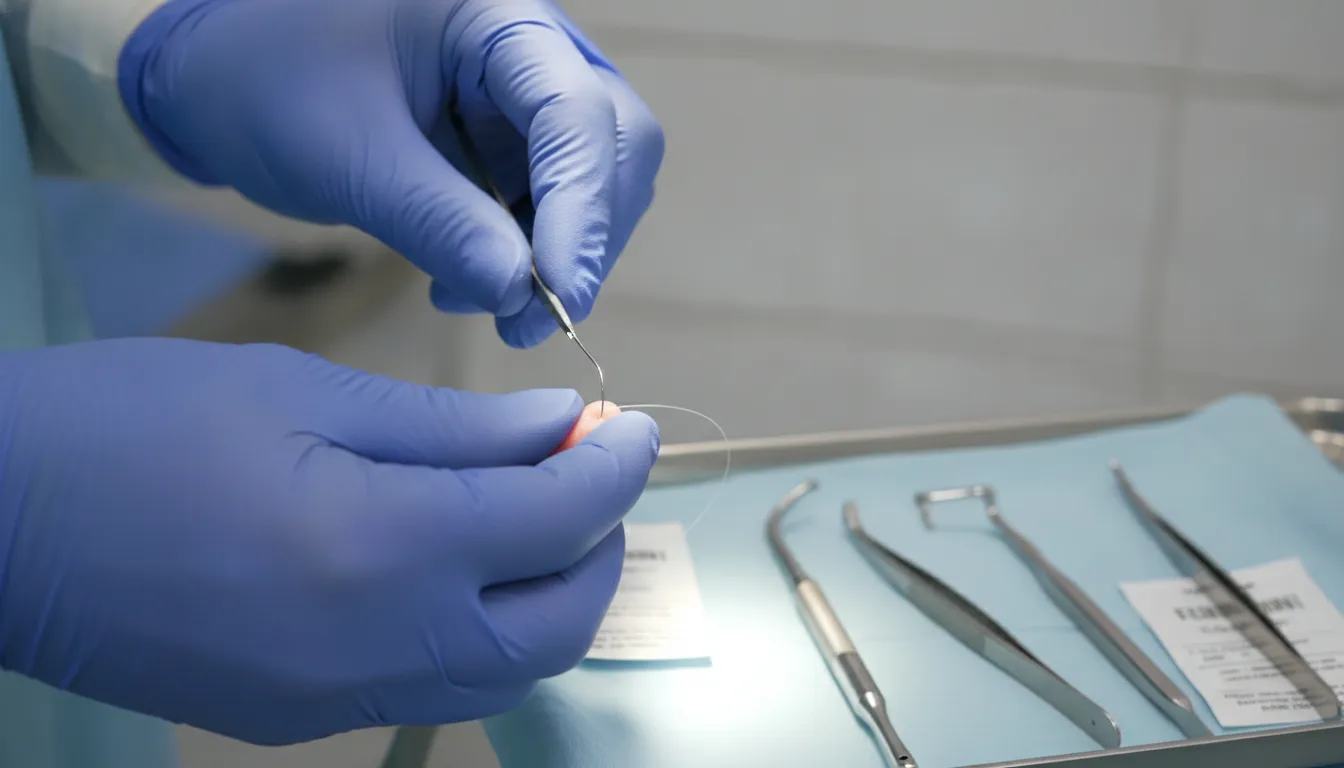
Non-absorbable monofilament sutures remain intact until they are removed or intentionally retained, making them useful when a wound requires dependable support beyond the early healing period. In dental and oral surgery, material selection should account for tissue location, tension, expected healing, visibility, and whether a follow-up visit for removal is practical. Nylon and polypropylene are frequently considered when low tissue reaction and controlled skin or soft-tissue closure are priorities. The single-strand construction also creates less tissue drag than braided multifilament material, which can support precise needle passage and atraumatic approximation.
Nylon for controlled skin and soft-tissue closure
Nylon is one of the most familiar non-absorbable monofilament materials. It is commonly selected for external skin closure and selected soft-tissue applications where the clinician wants a relatively low-reactivity suture that can be removed after the wound has gained sufficient strength. Its smooth surface may help the suture pass through tissue with less resistance than a braided alternative. The appropriate size and removal timing still depend on the surgical site, tissue quality, tension, and the operator's clinical protocol.
Polypropylene for low tissue reaction
Polypropylene, often recognized by the Prolene-style material category, is another non-absorbable monofilament option. It is useful when prolonged support and low tissue reaction are important considerations. As with nylon, polypropylene can be considered for skin closure and selected soft-tissue repairs. But the final choice should reflect the wound environment rather than the material name alone. Needle profile, suture diameter, knot technique, and the need for postoperative assessment all affect clinical performance.
Stainless steel when extended mechanical support matters
Stainless steel monofilament sutures are reserved for situations in which substantial mechanical strength and extended support are part of the treatment plan. They require deliberate handling because stiffness, memory, and knot management can influence placement and patient comfort. Use should follow the procedure's tissue demands and the surgeon's technique, with careful attention to avoiding unnecessary tension or tissue injury. In oral surgery, sutures must stabilize soft tissue against varying hard-tissue surfaces, so material selection is inseparable from wound design and closure technique.
For practices sourcing these materials, the MacSuture collection provides a focused supply source for professional wound-closure needs. Review broader suture clinical uses when matching non-absorbable monofilament characteristics to a specific procedure. Across nylon, polypropylene, and stainless steel, the objective remains the same: achieve accurate approximation with adequate support while limiting avoidable tissue reaction and trauma.
Which Absorbable Monofilament Examples Support Prolonged Healing?
Absorbable monofilament sutures are useful when a wound needs reliable support during healing, but routine suture removal is undesirable or impractical. Two important examples are polydioxanone, commonly called PDS, and poliglecaprone 25, commonly known by the brand name Monocryl. Both are synthetic, single-strand materials, yet their support and absorption profiles differ enough to influence material selection for oral and soft-tissue procedures.
Polydioxanone (PDS) for prolonged wound support
PDS is a monofilament absorbable suture characterized by prolonged breaking-strength retention, a reliable absorption profile, and minimal tissue reaction. That combination makes it appropriate when clinicians want wound support to continue through an extended postoperative period rather than selecting a material that loses strength quickly. The original clinical evaluation of polydioxanone reported that it provides extended wound support and is most useful when prolonged suture integrity is desirable. Review the clinical evidence on polydioxanone for additional detail.
In comparative evaluation, PDS was rated significantly superior to gut in every category assessed, including handling and clinical performance. That finding does not replace clinical judgment, but it helps explain why PDS remains a practical option when predictable synthetic material behavior and longer support are priorities. TeachMeSurgery lists PDS at approximately 200 days for absorption, although the exact clinical course depends on the specific product, tissue environment, and patient factors. See the referenced suture-material classification overview.
Poliglecaprone 25 (Monocryl) for shorter-term support
Poliglecaprone 25, or Monocryl, is another synthetic absorbable monofilament. Its approximate absorption timeline is 100 days, notably shorter than the approximately 200-day timeline commonly cited for PDS. This difference can matter when the wound requires temporary approximation but does not call for the prolonged support associated with polydioxanone. Select the material according to the closure site, tissue characteristics, anticipated healing course, tension, and the clinician's preferred handling properties.
Absorption time should never be treated as the only selection criterion. Suture diameter, needle design, knot security, tissue response, and the need for postoperative support all contribute to an appropriate choice. In oral surgery, the closure must also maintain soft-tissue adaptation against underlying hard tissue while supporting healing with minimal tension. For practices sourcing consistent absorbable and non-absorbable options, the MacSuture collection provides a focused starting point for reviewing professional wound-closure supplies.
How Do You Choose the Right Monofilament Suture Size for Oral Surgery?
Suture selection in oral surgery should reflect the tissue being reapproximated, the amount of tensile support required, the closure technique, and the expected healing environment. Dental surgeons face a distinctive technical challenge: oral procedures often require soft tissue to be reapproximated and stabilized against different types of hard tissue. The suture must support accurate flap or wound-edge adaptation without creating unnecessary tissue trauma.
Use the USP scale to compare diameter
The United States Pharmacopeia (USP) sizing system expresses suture diameter through numbers and zeros. A greater number of zeros indicates a finer strand, so a 6-0 suture is finer than a 3-0 suture. Finer sizes can be useful when minimizing tissue disruption and improving the handling of delicate soft tissue is a priority. Larger diameters provide greater material bulk and may be selected when the closure requires more tensile support.
In general, sizes around 0 to 1-0 are associated with fascia or other substantial tissue closures that require high strength. Sizes from 4-0 through 7-0 are commonly used for skin and delicate structures. These ranges are orientation points, not automatic prescriptions for every oral procedure. The surgeon should match the size to tissue thickness, wound tension, needle profile, material properties, and the planned duration of support.
Apply size selection to oral soft-tissue closure
For many dental and oral surgical closures, the objective is precise edge approximation with minimal tension. Excessive tension can compromise adaptation and may interfere with healing by primary intention. Proper reapproximation supports hemostasis and can help minimize post-surgical bone loss at surgical sites. A smaller monofilament may be appropriate when the tissue is thin and delicate, provided it can maintain the required approximation without cutting through the tissue.
Conversely, choosing a strand that is too fine for the closure can reduce handling confidence or fail to provide adequate support. A larger size may be more appropriate when tissue thickness, movement, or tension demands stronger initial support. The material also matters. Nylon and polypropylene are non-absorbable monofilaments often used where low tissue reaction is important. While absorbable options such as polydioxanone (PDS) provide prolonged wound support when extended suture integrity is clinically desirable.
When evaluating monofilament suture examples, compare USP size alongside absorbability, tensile-strength retention, needle configuration, and the specific closure technique. A clinically appropriate size is the one that secures the tissue reliably while allowing atraumatic placement and a clean, stable closure.
Sourcing Quality Monofilament Sutures for Your Practice
Choosing a monofilament suture supplier is a clinical and operational decision, not simply a purchasing task. Dental practices need materials that match the procedure, are labeled with accurate USP sizing, and arrive consistently when surgical schedules and inventory demands change. A dependable sourcing process helps clinicians maintain procedural standards while reducing last-minute substitutions that may not provide the handling or tissue response expected.
Start by confirming the material, absorbability classification, diameter, needle configuration, and package details for every product under consideration. Nylon and polypropylene are commonly selected non-absorbable monofilaments when low tissue reaction is important. Polydioxanone offers an absorbable monofilament option when extended wound support is clinically appropriate. Product selection should remain tied to the procedure, tissue characteristics, closure technique, and the clinician's judgment rather than to material names alone.
Verify USP sizing before placing a wholesale order
Accurate sizing is essential when comparing products across brands or replenishing a standard surgical tray. Under the USP system, a greater number of zeros indicates a finer diameter, so 6-0 is finer than 3-0. Confirm that the listed size matches the package label and the practice's ordering specification. Also verify whether the product listing identifies the needle type, curvature, point style, length, strand material, and sterile packaging. These details affect instrument handling and tissue approximation, and they should not be assumed from a general product description.
Dental surgeons often re-approximate soft tissue against varying hard tissues, creating demands that differ among extraction, implant, periodontal, and other oral procedures. Closure should support wound-edge approximation with minimal tension, a goal associated with healing by primary intention and reduced risk of post-surgical bone loss. A supplier that provides clear specifications makes it easier for clinicians and purchasing teams to select the appropriate configuration for each use.
Build a dependable practice supply program
For recurring needs, evaluate suppliers on more than unit price. Review lot and expiration information, sterile packaging integrity, case-pack quantities, reorder consistency, and responsiveness when a product is unavailable. A national supplier should also make it practical to consolidate routine dental and surgical supply orders without sacrificing product transparency. SurgiMac's MacSuture collection gives practices a focused starting point for reviewing wound-closure options and aligning routine orders with clinical requirements.
Use the suture clinical uses resource to compare material behavior and procedural context, then consult the dental sutures buying guide when standardizing sizes, needles, and quantities. SurgiMac supports U.S. dental professionals with premium, reliable, and affordable supply options, helping practices source monofilament sutures with the documentation and consistency needed for confident purchasing.
Stock your practice with the MacSuture monofilament collection
Frequently Asked Questions
What are common examples of monofilament sutures?
Common monofilament suture examples include nylon (polyamide) and polypropylene, which are non-absorbable, and polydioxanone (PDS) and poliglecaprone 25 (Monocryl), which are absorbable. Stainless steel is a less common but strong non-absorbable monofilament used in selected high-strength closures. Each material offers a single-strand construction that reduces tissue drag and provides fewer spaces for bacterial harboring compared with braided multifilament materials. The material, the intended duration of wound support, the tissue location, and the planned follow-up should all guide selection rather than the product name alone.
Are monofilament sutures absorbable or non-absorbable?
They can be either. PDS and poliglecaprone are absorbable monofilaments used when the closure can gradually lose support as healing progresses. Nylon and polypropylene are non-absorbable and may be selected when prolonged tensile support or later removal is appropriate. PDS is documented to retain breaking strength for an extended period and to produce minimal tissue reaction. Which is why it is often used for closures that require wound support over a longer postoperative window (PubMed).
Which monofilament suture examples are used for skin closure?
Nylon and polypropylene are common choices for external skin or soft-tissue closure when a low tissue reaction is important. Monofilaments are generally preferred for skin closure because their single-strand structure creates less tissue drag than braided multifilament material as the suture passes through tissue (NCBI Bookshelf). Fine sizes such as 5-0 and 6-0 are typically used for delicate facial and intraoral closures. Every clinician should follow the procedure-specific technique and removal plan established by the treating practitioner.
Do monofilament sutures require special handling?
They may require deliberate handling because a single strand can have more memory and may not lie as flat or grip as readily as braided material. Use controlled instrument technique, maintain appropriate tension, and secure knots according to the material and manufacturer instructions. In oral surgery, accurate edge approximation with minimal tension supports healing by primary intention, which helps minimize post-surgical bone loss at the site (NCBI Bookshelf). Choosing a monofilament with handling characteristics suited to the procedure reduces the need for compensating technique.
Stock Your Practice with Quality Monofilament Sutures from SurgiMac
Consistent wound closure depends on dependable materials. SurgiMac supplies premium, clinically accurate monofilament sutures to dental and surgical practices nationwide, backed by reliable sourcing and competitive wholesale pricing.
Build your inventory with sutures you can trust for every procedure, whether you are restocking core sizes or preparing for busier chairside days.
Ready to supply your practice with confidence? Explore the MacSuture collection to see our full range, compare options, and request bulk pricing from the SurgiMac team.
Tags
Blog posts
-
, by SurgiMac A Clinician's Guide to Absorbable Suture Material
-
, by SurgiMac A Clinician's Guide to Dental Composite Resin Kits
-
, by SurgiMac How to Disinfect with Metrex CaviWipes Correctly
