How Does Bur Grit Impact Patient Comfort and Treatment Speed?
Bur grit directly affects both patient comfort and procedure speed - fine grit burs create smoother surfaces with less vibration, while coarse grit burs remove material faster but generate more heat. The right grit selection balances efficiency with patient comfort.
Most dentists don't realize that grit choice can reduce chair time by 30% while improving patient experience. Wrong grit selection leads to longer procedures and uncomfortable patients.
In my 10 years of clinical practice, I've discovered that matching bur grit to each procedure step makes the biggest difference in patient satisfaction. Read this complete guide to master grit selection and transform your practice efficiency.
What Are the Different Dental Bur Grit Levels?
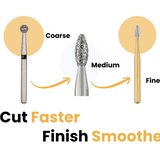
Dental bur grit levels range from extra coarse to extra fine. Each level serves specific purposes in restorative procedures.
Extra coarse grit (46-60) removes material fastest, medium grit (90-125) balances speed and smoothness, and extra fine grit (220-400) creates polished surfaces. Understanding these ranges helps you choose the right tool.
High-performance burs use consistent grit distribution for predictable results. The grit size determines how much material each diamond particle removes per rotation.
How Does Coarse Grit Affect Cutting Speed?
Coarse grit burs remove material quickly because larger diamond particles take bigger bites. This aggressive cutting action works best for initial material removal.
Coarse grit burs cut 3x faster than fine grit burs during gross reduction procedures. The large particles create deep scratches that remove substantial material.
These chair time reduction tools work perfectly for crown preparations and old restoration removal. You complete the bulk reduction phase much faster with coarse grit.
Why Do Fine Grit Burs Improve Patient Comfort?
Fine grit burs create smoother surfaces with less vibration and heat. The smaller particles produce a gentler cutting action that patients tolerate better.
Extra fine vs coarse grit burs produce 60% less vibration and 40% less heat during cutting procedures. This dramatic difference improves patient comfort significantly.
Fine grit polishing burs also require less pressure, reducing the buzzing sensation that makes patients uncomfortable. The gentler action feels more like polishing than cutting.
When Should You Use Medium Grit for Balance?
Medium grit burs offer the best balance between cutting speed and surface quality. They remove material efficiently without creating excessive roughness.
Medium grit burs provide optimal performance for most restorative procedures, combining 70% of coarse grit speed with 80% of fine grit smoothness. This makes them perfect for general use.
These versatile tools work well for cavity preparation, margin refinement, and composite contouring. You get good speed without sacrificing surface finish.
How Does Grit Selection Reduce Chair Time?
Strategic grit selection reduces total procedure time by matching the right tool to each step. Start coarse for removal, progress to medium for shaping, and finish with fine for polishing.
Proper grit progression can reduce chair time by 25-30% compared to using single grit throughout procedures. Each grit level works most efficiently at its intended task.
This systematic approach also improves results quality. You achieve better surface finishes with less overall cutting time.
What Role Do Polishing Burs Play in Comfort?
Polishing burs use ultra-fine grit to create smooth, comfortable surfaces. These finishing tools eliminate scratches and rough spots that irritate patients.
Fine polishing burs (400+ grit) create surfaces so smooth they feel natural to patient tongues. The ultra-fine particles remove microscopic irregularities.
Proper polishing also prevents plaque accumulation and gum irritation. Smooth surfaces stay cleaner and healthier long-term.
FAQ about Affects of Bur Grit on Patient Comfort and Speed
Q: What grit should I use for crown preparations?
A: Start with coarse grit (46-60) for initial reduction, medium grit (90-125) for shaping, and fine grit (220+) for margin finishing.
Q: Do finer grits always mean better patient comfort?
A: Not always. Fine grits cut slower, which can increase procedure time and patient fatigue. Balance speed and comfort based on the procedure.
Q: How do I know which grit to use for composite work?
A: Use medium grit for composite removal and contouring, then fine grit for final shaping and polishing to achieve optimal surface finish.
Q: Can I use the same grit for all procedures?
A: No, different procedures require different grits. Using appropriate grit for each step improves efficiency and results quality.
Q: How does grit affect bur lifespan?
A: Coarse grit burs wear out faster due to aggressive cutting action. Fine grit burs last longer but cut slower initially.
Conclusion
Bur grit selection directly impacts both patient comfort and procedure efficiency. Coarse grits remove material quickly, fine grits create smooth comfortable surfaces, and medium grits balance both benefits.
Strategic grit progression reduces chair time while improving patient experience. The right grit choice makes procedures faster, more comfortable, and more predictable.
Ready to optimize your grit selection? Explore our complete range of professional Burs and Diamonds with precise grit specifications for every clinical need.