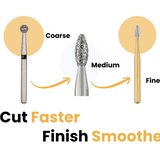
The sound and sensation of a dental handpiece are often a primary source of patient anxiety. As clinicians, we know that managing comfort is just as important as the clinical outcome. Much of the vibration and heat generated during a procedure comes down to a single factor: the bur grit. Using a bur that is too aggressive can cause discomfort, while one that is too fine can prolong the procedure. This article explores the direct link between bur grit and patient experience, showing you how to choose the right instrument to balance speed with comfort, ensuring your patients leave feeling positive about their care.
The ISO Color-Coding System for Grit Identification
One of the most practical ways to identify a diamond bur's abrasiveness is by its color-coded ring. This universal system, established by the International Organization for Standardization (ISO), allows clinicians to quickly select the right grit for any task, from bulk reduction to fine polishing. Understanding this system helps you work with greater efficiency and precision. Each color corresponds to a specific diamond particle size, making it easy to grab the exact instrument you need without having to read fine print in the middle of a procedure. Let's break down what each color signifies for your workflow.
Super Coarse (Black) and Coarse (Green)
When you need to perform significant material removal, look for the black or green bands. A black ring indicates a super-coarse grit, which is ideal for aggressive tooth reduction or removing old restorative materials like amalgam or crowns quickly and efficiently. The green ring signifies a coarse grit, which is slightly less aggressive but still highly effective for shaping and contouring during crown preparations or other major restorative work. Think of these burs as the workhorses for tasks that require rapid and substantial adjustments to the tooth structure before you move on to finer instruments.
Medium (Blue or No Band)
The blue ring represents a medium grit, one of the most versatile and frequently used options in any dental practice. If a bur has no colored band, it also typically defaults to a medium grit, making it a common standard. These burs are perfect for universal applications, such as preparing a tooth for a crown, performing gentle enamel reduction, or doing the initial shaping of composite materials. Their balanced abrasiveness allows for effective cutting without being overly aggressive, establishing them as a go-to for a wide range of everyday procedures where control and efficiency are key.
Fine (Red) and Extra Fine (Yellow)
For tasks requiring more detail and a smoother surface finish, the red and yellow bands are your best choice. The red ring indicates a fine grit, which is used for finishing restorations, contouring composite materials, and preparing the tooth surface for final polishing. An even smoother finish is achieved with the yellow-banded, extra-fine grit burs. These are excellent for delicate detailing, polishing enamel, and refining the margins of cosmetic restorations to create a seamless and natural look that blends perfectly with the surrounding dentition.
Super Fine (White)
The white ring signifies a super-fine grit, offering the least abrasive action for the ultimate finishing touch. These burs are reserved for the final stages of polishing composite or ceramic restorations to achieve a high-gloss, enamel-like luster that looks and feels natural. Using a white-banded bur is the last step in creating an exceptionally smooth surface, which not only enhances aesthetics but also helps reduce plaque accumulation and improve the long-term durability of the restoration. They are essential for achieving superior results in cosmetic and restorative dentistry.
The ISO Numbering System
Beyond the simple color-coding for grit, the ISO numbering system provides a comprehensive classification for all dental burs and diamonds. This 15-digit code offers a highly detailed description of the bur, ensuring you can order the exact tool you need with complete confidence. While memorizing the entire sequence isn't necessary, understanding its components can simplify inventory management and purchasing. The code systematically identifies the bur's material, shank type, head shape, grit size, and maximum head diameter. This standardized system eliminates guesswork, ensuring consistency and precision when you select instruments for your practice.
How Does Bur Grit Impact Patient Comfort and Treatment Speed?
Bur grit directly affects both patient comfort and procedure speed - fine grit burs create smoother surfaces with less vibration, while coarse grit burs remove material faster but generate more heat. The right grit selection balances efficiency with patient comfort.
Most dentists don't realize that grit choice can reduce chair time by 30% while improving patient experience. Wrong grit selection leads to longer procedures and uncomfortable patients.
In my 10 years of clinical practice, I've discovered that matching bur grit to each procedure step makes the biggest difference in patient satisfaction. Read this complete guide to master grit selection and transform your practice efficiency.
What is a Dental Bur?
Think of a dental bur as the essential "drill bit" for your handpiece. It's a small, precise rotary instrument designed to cut, grind, and shape hard tissues in the oral cavity, including tooth enamel, dentin, and bone. These indispensable tools are workhorses in daily practice, playing a critical role in a wide range of procedures. Whether you're performing a cavity preparation, shaping a tooth for a crown, or undertaking complex orthodontic or surgical work, the right bur is fundamental to achieving a successful clinical outcome. Their design, material, and shape are all engineered for specific tasks, making them one of the most versatile instruments in your toolkit.
The Role of Coarse and Fine Grits in a Single Procedure
Selecting the right grit is a balancing act between speed and precision. During a single procedure, you'll often switch between different grits to optimize your workflow. Coarse burs are your go-to for bulk reduction; their aggressive cutting action removes large amounts of tooth structure or restorative material quickly, saving valuable chair time. However, they leave a rough surface. Once the bulk work is done, you'll switch to fine or extra-fine burs. These are much less aggressive, allowing for precise shaping, smoothing margins, and creating a polished finish. This two-step approach ensures you work efficiently without sacrificing the quality and detail of the final restoration.
Understanding Dental Bur Classification
With so many options available, it's easy to feel overwhelmed. Thankfully, dental burs are organized using a standardized classification system that makes selection straightforward. Understanding this system helps you quickly identify the perfect tool for any given clinical situation. Burs are primarily categorized by four key characteristics: the material they are made from, their head shape, their grit size (specifically for diamond burs), and the type of shank that connects to the handpiece. Each of these elements dictates the bur's performance, speed, and ideal application. Mastering these classifications will allow you to build a versatile and efficient bur inventory for your practice.
Bur Materials: Choosing the Right Composition
The material of a dental bur determines its cutting efficiency, durability, and ideal use. Each composition offers distinct advantages, whether you're cutting through tough enamel, shaping delicate composites, or adjusting porcelain. Choosing the right material is the first step in ensuring your procedure is both smooth and effective. From the unparalleled hardness of diamond to the flexibility of steel, the bur's composition is tailored to interact with specific dental tissues and restorative materials, directly impacting the quality of your work and the longevity of the instrument itself.
Diamond Burs
Diamond burs are crafted by bonding fine diamond particles to a stainless steel base. As diamond is the hardest known natural substance, these burs are exceptionally effective for cutting through highly abrasive materials like tooth enamel and ceramics such as porcelain or zirconia. They are the top choice for crown preparations, veneer placements, and shaping hard tissues with high precision. The grit of the diamond particles can vary from super coarse for rapid reduction to super fine for creating a smooth, pre-polish finish on restorations.
Tungsten Carbide Burs
Tungsten carbide burs are known for their strength and durability, being roughly three times stiffer than steel. Their blade design, or "flutes," allows them to cut and chip away tooth structure efficiently, making them ideal for excavating decay, sectioning teeth for extractions, and preparing cavities. Unlike diamond burs that grind, carbide burs cut, which often results in a smoother finish on dentin. They maintain their sharpness over multiple uses and are highly effective for removing old metal restorations like amalgam fillings.
Steel Burs
While not as hard as carbide or diamond, steel burs offer greater flexibility and are more resistant to chipping and breaking. This makes them particularly useful at slower speeds for more delicate tasks. Steel burs are excellent for caries removal, especially near the pulp where a more tactile feel is needed, and for preparing the initial outline of a cavity. They are generally more affordable but tend to dull faster than their harder counterparts, making them better suited for single-use applications or less demanding procedures.
Ceramic Burs
Ceramic burs, often made from materials like zirconia or aluminum oxide, are a biocompatible and corrosion-resistant option. They are particularly effective for soft tissue contouring and adjusting acrylic or composite materials without generating significant heat, which reduces the risk of thermal damage to the pulp or surrounding tissues. Their unique composition also allows for the gentle removal of soft, decayed dentin, leaving the healthier tooth structure intact. They are a great choice for clinicians focused on minimally invasive dentistry.
Bur Shapes and Their Clinical Applications
The shape of the bur head is specifically designed to perform a certain function. From creating initial access to fine-tuning the final anatomy of a restoration, each contour and angle serves a clinical purpose. Selecting the correct shape is just as important as choosing the right material, as it dictates how you can access, shape, and finish a preparation. Familiarizing yourself with the most common shapes and their applications will streamline your procedures and help you achieve more predictable and esthetic results for your patients.
Round and Pear Burs
Round burs, also known as ball burs, are among the most versatile shapes in dentistry. They are primarily used for initial entry into the tooth, removing decay, and creating retention features in cavity preparations. Their spherical shape is also perfect for creating access points for endodontic procedures. Pear-shaped burs are similar but offer a slightly tapered design, making them ideal for creating the smooth, flowing walls needed for composite fillings and other conservative restorations, combining decay removal and cavity shaping into one step.
Cylinder and Inverted Cone Burs
Cylinder burs, available with flat or rounded ends, are designed for preparing flat surfaces and parallel walls, which is essential for crown and bridge preparations. They excel at bulk material removal and creating a clear path of insertion for prosthetic restorations. Inverted cone burs, on the other hand, have a shape that is wider at the tip than at the base. This design is perfect for creating undercuts for mechanical retention in amalgam fillings and for flattening the floor of a cavity preparation with precision.
Flame and Finishing Burs
Flame-shaped burs are characterized by their pointed, tapered design, which makes them perfect for detailed anatomical contouring, shaping, and finishing. They are frequently used to refine the occlusal surfaces of posterior restorations or to create delicate chamfer margins during crown preparations. Finishing burs, which come in a variety of shapes, typically have more flutes (for carbide) or a finer grit (for diamond). These burs are used at the final stage to smooth surfaces, polish restorations, and adjust occlusion, ensuring a seamless and comfortable final result.
Shank Types and Handpiece Compatibility
The shank is the part of the bur that fits into your handpiece, and not all shanks are created equal. Ensuring you have the right shank type for your handpiece is critical for both safety and performance. An incompatible bur can lead to poor cutting efficiency, damage to your equipment, or even become a safety hazard. The three main shank types—Friction Grip (FG), Latch-Type (RA), and Straight Handpiece (HP)—are designed for specific handpieces and rotational speeds, each tailored to different clinical and laboratory tasks.
Friction Grip (FG) for High-Speed Handpieces
Friction Grip (FG) burs are designed for use in high-speed handpieces, which operate at speeds of 300,000 to 450,000 rpm. These shanks are smooth and are held in the handpiece by a friction-based chuck. Due to their high speed, FG burs are the standard for procedures requiring efficient cutting of hard tissues like enamel, such as crown preparations or sectioning teeth. They always require water coolant to prevent overheating and potential damage to the tooth's pulp.
Latch-Type (RA) for Slow-Speed Handpieces
Latch-Type (RA) burs, which stands for "Right Angle," are used with slow-speed contra-angle handpieces. These shanks have a small notch at the base that locks into the handpiece's latch mechanism, ensuring a secure fit at lower speeds (around 5,000 to 40,000 rpm). RA burs are ideal for tasks that require more control and tactile feedback, such as removing decay, refining preparations, polishing restorations, and performing prophylaxis. Their slower, more deliberate action makes them a staple for finishing work.
Straight Handpiece (HP) for Lab Work
Straight Handpiece (HP) burs have the longest shank and are designed for use with slow-speed straight handpieces. While they can be used for some intraoral surgical procedures, their primary application is in the dental laboratory. Lab technicians use HP burs for adjusting dentures, trimming models, and working with various prosthetic materials. Their length provides better access and control for detailed work outside of the mouth, making them an essential tool for crafting and refining dental prosthetics.
What Are the Different Dental Bur Grit Levels?
Dental bur grit levels range from extra coarse to extra fine. Each level serves specific purposes in restorative procedures.
Extra coarse grit (46-60) removes material fastest, medium grit (90-125) balances speed and smoothness, and extra fine grit (220-400) creates polished surfaces. Understanding these ranges helps you choose the right tool.
High-performance burs use consistent grit distribution for predictable results. The grit size determines how much material each diamond particle removes per rotation.
How Does Coarse Grit Affect Cutting Speed?
Coarse grit burs remove material quickly because larger diamond particles take bigger bites. This aggressive cutting action works best for initial material removal.
Coarse grit burs cut 3x faster than fine grit burs during gross reduction procedures. The large particles create deep scratches that remove substantial material.
These chair time reduction tools work perfectly for crown preparations and old restoration removal. You complete the bulk reduction phase much faster with coarse grit.
Why Do Fine Grit Burs Improve Patient Comfort?
Fine grit burs create smoother surfaces with less vibration and heat. The smaller particles produce a gentler cutting action that patients tolerate better.
Extra fine vs coarse grit burs produce 60% less vibration and 40% less heat during cutting procedures. This dramatic difference improves patient comfort significantly.
Fine grit polishing burs also require less pressure, reducing the buzzing sensation that makes patients uncomfortable. The gentler action feels more like polishing than cutting.
When Should You Use Medium Grit for Balance?
Medium grit burs offer the best balance between cutting speed and surface quality. They remove material efficiently without creating excessive roughness.
Medium grit burs provide optimal performance for most restorative procedures, combining 70% of coarse grit speed with 80% of fine grit smoothness. This makes them perfect for general use.
These versatile tools work well for cavity preparation, margin refinement, and composite contouring. You get good speed without sacrificing surface finish.
How Does Grit Selection Reduce Chair Time?
Strategic grit selection reduces total procedure time by matching the right tool to each step. Start coarse for removal, progress to medium for shaping, and finish with fine for polishing.
Proper grit progression can reduce chair time by 25-30% compared to using single grit throughout procedures. Each grit level works most efficiently at its intended task.
This systematic approach also improves results quality. You achieve better surface finishes with less overall cutting time.
What Role Do Polishing Burs Play in Comfort?
Polishing burs use ultra-fine grit to create smooth, comfortable surfaces. These finishing tools eliminate scratches and rough spots that irritate patients.
Fine polishing burs (400+ grit) create surfaces so smooth they feel natural to patient tongues. The ultra-fine particles remove microscopic irregularities.
Proper polishing also prevents plaque accumulation and gum irritation. Smooth surfaces stay cleaner and healthier long-term.
FAQ about Affects of Bur Grit on Patient Comfort and Speed
Q: What grit should I use for crown preparations?
A: Start with coarse grit (46-60) for initial reduction, medium grit (90-125) for shaping, and fine grit (220+) for margin finishing.
Q: Do finer grits always mean better patient comfort?
A: Not always. Fine grits cut slower, which can increase procedure time and patient fatigue. Balance speed and comfort based on the procedure.
Q: How do I know which grit to use for composite work?
A: Use medium grit for composite removal and contouring, then fine grit for final shaping and polishing to achieve optimal surface finish.
Q: Can I use the same grit for all procedures?
A: No, different procedures require different grits. Using appropriate grit for each step improves efficiency and results quality.
Q: How does grit affect bur lifespan?
A: Coarse grit burs wear out faster due to aggressive cutting action. Fine grit burs last longer but cut slower initially.
Conclusion
Bur grit selection directly impacts both patient comfort and procedure efficiency. Coarse grits remove material quickly, fine grits create smooth comfortable surfaces, and medium grits balance both benefits.
Strategic grit progression reduces chair time while improving patient experience. The right grit choice makes procedures faster, more comfortable, and more predictable.
Ready to optimize your grit selection? Explore our complete range of professional Burs and Diamonds with precise grit specifications for every clinical need.
Bur Durability, Maintenance, and Sterilization
Even the highest-quality dental bur won't perform well without proper care. A bur's lifespan and cutting efficiency depend heavily on your maintenance and sterilization protocols. Implementing a consistent system not only protects your investment but also ensures every procedure is safe, predictable, and comfortable for your patients. Think of bur maintenance not as a chore, but as a critical step in your clinical workflow that upholds your standard of care. Neglecting it can lead to premature wear, reduced performance, and potential cross-contamination risks, undermining the precision you work so hard to achieve in every restoration.
When to Replace Your Dental Burs
Knowing when to retire a bur is key to maintaining clinical efficiency and patient safety. After each use, visually inspect your burs for signs of wear, such as dull or chipped cutting surfaces, discoloration, or a bent shank. A worn bur requires more pressure to cut, which generates excess heat and vibration, causing patient discomfort and putting unnecessary strain on your handpiece. Continuing to use a compromised bur is a false economy; it slows down your procedure and can lead to a subpar preparation with poor margin integrity. Establishing a clear replacement schedule based on usage frequency helps ensure you are always working with sharp, effective instruments.
Proper Cleaning and Sterilization Protocols
Effective sterilization begins with meticulous cleaning. Immediately after use, pre-soak your burs in an enzymatic solution or a disinfectant designed for dental instruments to prevent bioburden from drying. Following the pre-soak, thoroughly clean them using an ultrasonic cleaner or by manually scrubbing with a wire brush to remove all visible debris. This step is non-negotiable, as any remaining organic material can shield microorganisms from the sterilization process. Once the burs are clean and dry, they are ready for sterilization. Autoclaving (steam sterilization) is the most common and recommended method for its reliability and effectiveness in eliminating all microbial life.
Beyond the Bur: Essential Finishing and Polishing Tools
A successful restoration goes beyond precise cutting and shaping; the final surface texture is just as important. This is where finishing and polishing tools come in. Finishing involves contouring the restoration and smoothing out any roughness left by preparation burs, while polishing creates a high-luster, enamel-like surface. This two-step process is crucial not only for aesthetics but also for the long-term health and durability of the restoration. A properly polished surface minimizes plaque accumulation, reduces staining, and prevents irritation to the surrounding soft tissues and the patient's tongue, contributing to better overall oral hygiene.
Using a sequence of progressively finer grits is the key to achieving a flawless finish. Start with fine-grit diamond or carbide finishing burs to refine anatomy and margins. Then, move to extra-fine polishing points, cups, or discs to create a smooth, reflective surface. This meticulous approach ensures the restoration integrates seamlessly with the natural dentition and contributes to overall oral health. Investing time in finishing and polishing enhances patient satisfaction and reflects the quality of your clinical work. For a complete selection of tools, you can explore a wide range of burs and diamonds designed for every stage of the restorative process.